 05 October, 2026 |
  Admin
Admin
PTFE Components for Food &
Food and beverage processing equipment needs
Read more
Enquire Now
 01 October, 2026 | Admin
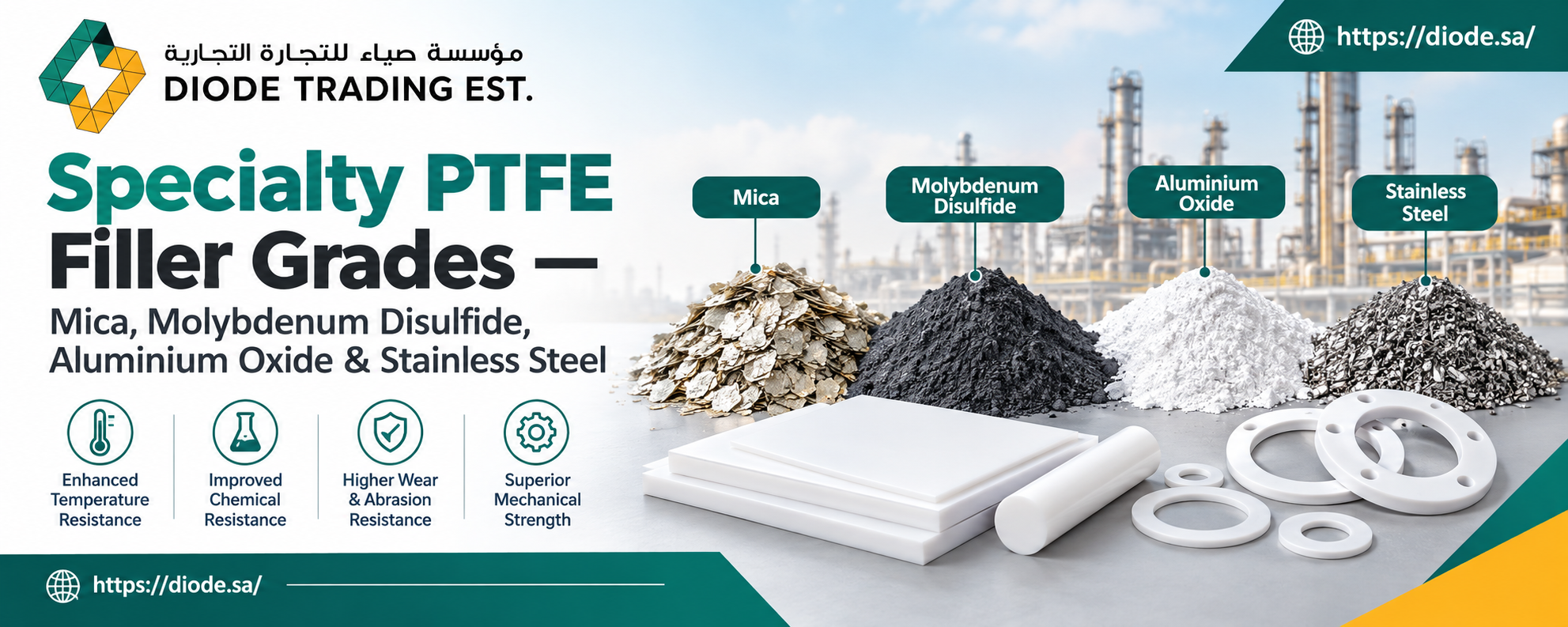
Beyond the common glass, carbon and bronze-filled PTFE grades, several more specialised filler combinations exist for specific mechanical and environmental demands. These specialty PTFE filler grades are refinements for unusual duty, not a default starting point. This guide covers four worth knowing about: mica, molybdenum disulfide (MoS2), aluminium oxide and stainless steel-filled PTFE.
| Filler Type | Key Property Improvement | Typical Application |
|---|---|---|
| Mica-filled | Improved dimensional stability, reduced cold flow | Precision components needing tight tolerance retention |
| Bronze + Molybdenum Disulfide | High compressive strength plus enhanced lubricity | Heavy-load, high-cycle dynamic components |
| Glass + MoS2 combination | Balanced wear resistance and low friction | Dynamic seals under moderate load |
| Aluminium Oxide-filled | High hardness, abrasion resistance | Abrasive-service wear components |
| Stainless Steel-filled | High thermal conductivity, wear resistance | Applications needing heat dissipation through the component |
Properties and values described here are typical and are confirmed on quotation for your project.
Single-filler grades such as pure glass-filled or pure carbon-filled PTFE each improve one property at the cost of others. Combination fillers, like bronze plus molybdenum disulfide or glass plus MoS2, are formulated to balance two properties simultaneously, such as high compressive strength alongside good lubricity, which a single filler often cannot deliver together.
Before moving to a specialty grade, review the standard options: glass-filled PTFE, carbon-filled PTFE and bronze-filled PTFE. Our PTFE grades guide compares them against virgin PTFE.
These grades are generally worth considering when a standard glass, carbon or bronze-filled PTFE has not delivered the service life or performance expected in your specific application. They suit demanding or unusual duty cycles such as heavy-load dynamic parts, abrasive service, or components that must carry heat away.
For the wider range, see PTFE products.
Generally yes, given their more specialised formulation and typically lower production volume. They are usually specified when a standard filled grade has not met the application's specific performance requirement, not as a general-purpose default.
Molybdenum disulfide filled PTFE gains enhanced lubricity, and in combination with bronze or glass it balances load capacity with low friction.
Mica improves dimensional stability and reduces cold flow, so it suits precision components that must retain tight tolerances.
Tell our Al Khobar team about your application, load, temperature and quantities, and send drawings if available, and we will advise whether a specialty PTFE grade is worth specifying and quote supply.
See our range of high-visibility safety mats and markers designed to reduce trip hazards across your site.
 05 October, 2026 | Admin
Food and beverage processing equipment needs
Read more 05 October, 2026 | Admin
Pharmaceutical manufacturing environments dem
Read more 04 October, 2026 | Admin
Semiconductor and electronics manufacturing p
Read more