How to Select the Right PTFE Grade for Your Application
 01 October, 2026 |
 Admin
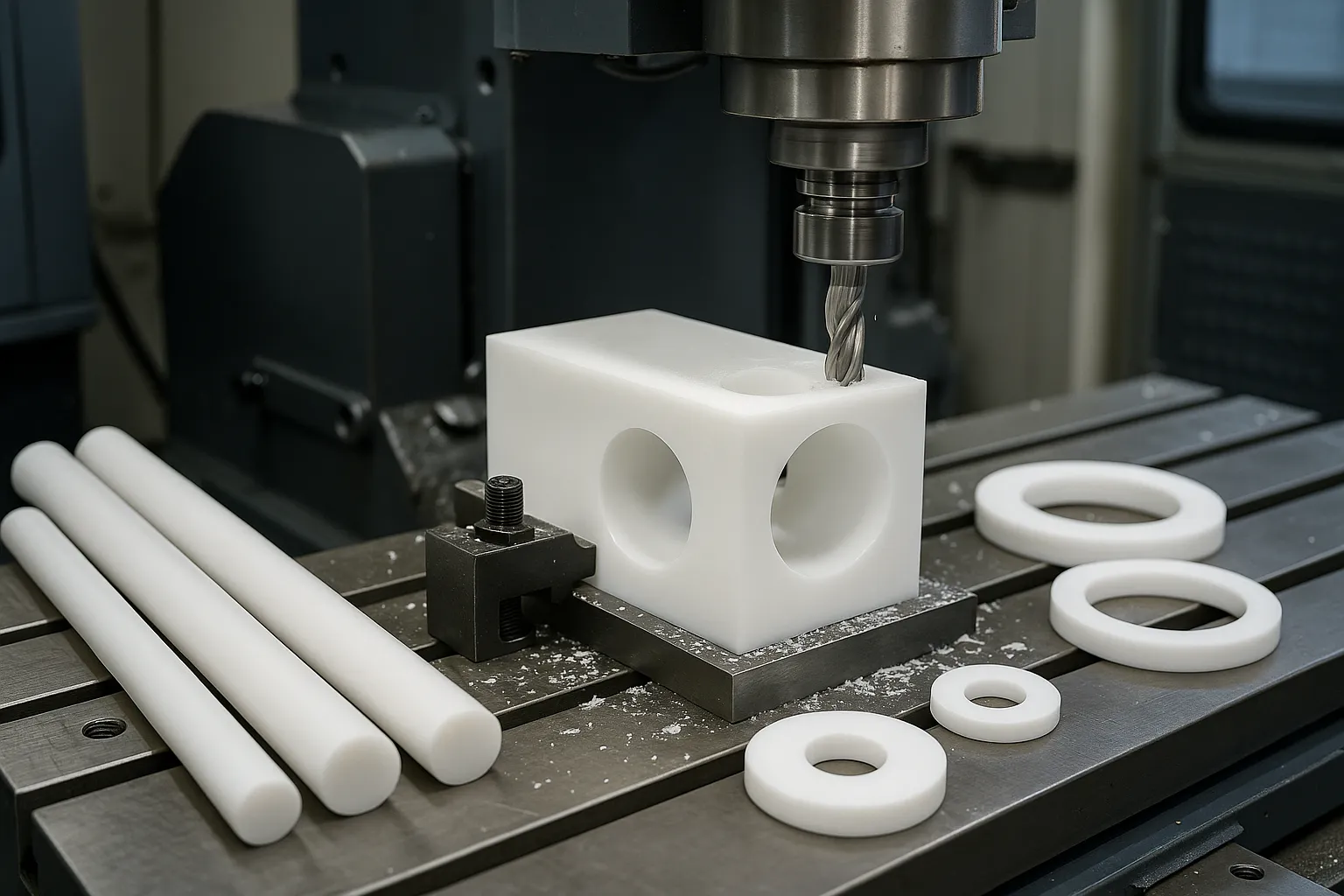
Select PTFE Grade: With half a dozen PTFE grades on the market, choosing the right one comes down to answering four questions in order. Skip a step and you risk specifying a grade that fails prematurely — or paying more than you need to.
Step 1 — What is the part exposed to chemically?
If the part will see strong alkalis or hydrofluoric acid, rule out glass-filled grades. If it will see strong oxidizers, rule out carbon-filled. If it will see acids or moisture, rule out bronze-filled. If in doubt or exposure is mixed/unknown, virgin or glass-filled PTFE is the safer default.
Step 2 — Is the part under sustained mechanical load?
Static seals and gaskets with light, even loading can use virgin PTFE. Anything with continuous pressure, rotation, or sliding contact (bearings, bushings, wear rings, piston seals) needs a filled grade — glass for general use, carbon for high-PV service, bronze for the heaviest unidirectional loads in non-corrosive settings.
Step 3 — Does the application require food, pharma, or high-purity compliance?
If yes, only virgin PTFE (FDA/USP Class VI compliant) is acceptable — filled grades are generally not used for direct food or pharmaceutical contact unless the specific compound carries the required certification.
Step 4 — What is the operating temperature range?
All PTFE grades share the same practical range (roughly -200°C to +260°C), so temperature rarely changes the grade decision — but always confirm against the specific application’s continuous and peak temperatures.
Worked Example
A pump shaft bushing in a desalination plant: exposed to seawater (moisture/mild corrosion) and continuous rotation under load, no food-contact requirement. Bronze-filled is ruled out (corrosion risk from seawater), so glass-filled or carbon-filled PTFE is the right call — carbon-filled if the load/speed combination is high, glass-filled if moderate.
More Worked Examples
Ball Valve Seats on a Chemical Line
The seat sees acids and solvents, and it is loaded every time the valve closes. Virgin PTFE gives the best seal at moderate pressure. Where pressure or temperature is higher, glass-filled PTFE resists creep better, provided the line does not carry strong alkalis or hydrofluoric acid.
Hydraulic Cylinder Guide Rings
The ring runs in clean hydraulic oil under heavy, continuous sliding load with no corrosion risk. Bronze-filled PTFE is the usual choice for its load capacity and heat transfer.
Gasket for a Food Processing Line
The flange sees hot water, cleaning chemicals and direct food contact with light, even loading. Virgin PTFE with food-contact compliance is the right call. If cold flow is a problem, an expanded PTFE gasket with the required certification is the next option to consider.
Non-Lubricated Compressor Piston Rings
The rings run dry at high speed against a metal cylinder. Carbon or carbon-graphite filled PTFE is normally chosen for low wear without lubrication.
Common Specification Mistakes
- Specifying virgin PTFE for a loaded bearing. It will creep and wear quickly. Use a filled grade.
- Using glass-filled PTFE in strong alkali or HF service. The glass is attacked and the part degrades.
- Choosing bronze-filled PTFE for wet or acidic duty. The bronze corrodes.
- Ignoring the mating surface. Abrasive fillers such as glass can wear soft shafts. Check shaft hardness and finish.
- Specifying by price alone. A cheaper grade that fails early costs more in downtime than the material saves.
What to Send With Your Enquiry
To recommend a grade quickly, our team needs the process chemicals, the operating temperature range, the type of load (static, sliding or rotating), any food or pharmaceutical requirement, and a drawing or dimensions with quantities. Every order from Diode is supplied with a Material Test Certificate, so the grade you specify is documented for future reorders.
For detailed chemical compatibility by grade, see our PTFE chemical compatibility and temperature guide. For grade properties, see the PTFE Grades Guide and Virgin vs Filled PTFE.
Explore Further
Select PTFE Grade: Next Steps
For select PTFE grade questions, product data or a quotation, contact Diode Trading EST at sales@diode.sa or browse our product range. Every order ships with a Material Test Certificate, and our quality system is certified to ISO 9001.
Need advice on select PTFE grade? Contact our team at sales@diode.sa for product data and a quotation.
Recent Posts

High Visibility Reduce Trip Hazards
See our range of high-visibility safety mats and markers designed to reduce trip hazards across your site.
Related Blogs