PTFE Slide Plates: Short answer: A PTFE slide plate is a low-friction surface used in sliding bridge bearings. It lets the bridge deck expand, contract and rotate as temperature and traffic change, without transferring large forces into piers. It works with a polished stainless steel mating surface, and the design is normally set by the bridge engineer.
Bridges move. Heat expands the deck, cold shrinks it, and traffic loads cause rotation. If the structure is held rigidly, forces build up and cause damage. Sliding bearings solve this by letting one part slide on another with very little friction. PTFE is the standard sliding material because it has one of the lowest friction coefficients of any solid.
How a sliding bearing works
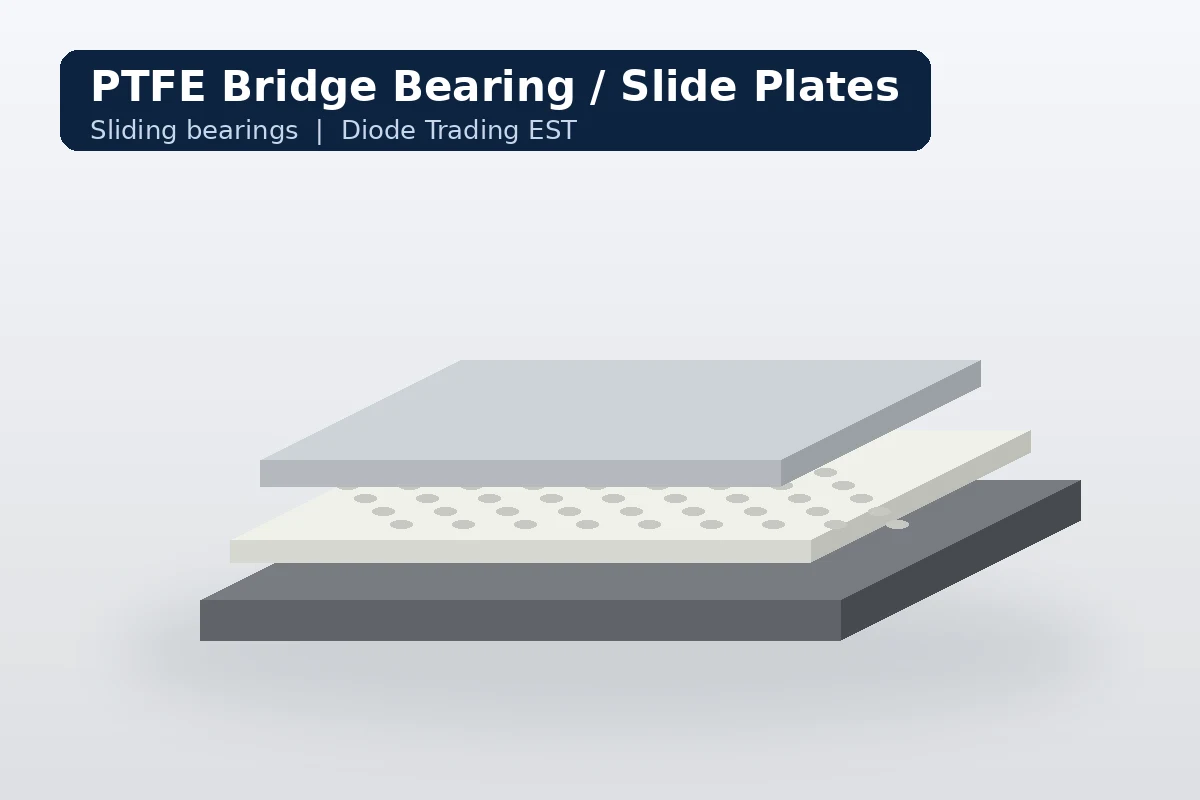
A PTFE sheet is recessed or bonded into a steel plate. It slides against a polished stainless steel surface. When the deck moves, the stainless plate slides over the PTFE with low resistance. The bearing also carries the vertical load of the deck, so the PTFE must survive high contact pressure without squeezing out.
Why PTFE
- very low friction, so horizontal forces are small
- stable in outdoor conditions and temperature swings
- does not absorb water
- long service life when kept clean and correctly loaded
Design points that affect performance
- Recess depth: PTFE is usually held in a recess so it cannot flow sideways under load.
- Mating surface: stainless steel must be smooth and clean. Scratches and dirt wear the PTFE.
- Contact pressure: designers limit the pressure on the PTFE. The limit depends on the PTFE type and the governing standard.
- Dimpled PTFE: some designs use dimples that hold lubricant, which further reduces friction.
- Sliding distance: long travel means more wear, so the thickness must suit the design life.
Related components
PTFE slide plates are often used with elastomeric or pot bearings. For the rubber side, see bridge bearing pads and neoprene bearing pads.
What to specify when ordering
- the governing standard or specification of the project
- PTFE size, thickness and recess details
- plain or dimpled
- quantity and delivery schedule
- test certificates required
The design and approval of bridge bearings sits with the project engineer, so share the approved drawing with the supplier. Diode Trading EST supplies PTFE products across Saudi Arabia, and every order ships with a Material Test Certificate. Request a quote.
Handling on site
Keep PTFE and stainless surfaces clean and protected until installation. Do not lubricate with unapproved grease. Check that the bearing is installed level and in the specified position.
Installation and inspection
Bridge bearings are installed to the engineer’s method. In general the PTFE and stainless steel faces must be protected from dust, grit, grease and weld spatter until the bearing is in place, because dirt trapped between the faces scratches the surfaces and increases friction. Check that the bearing is level, correctly aligned in the direction of movement and fixed to the bearing plates as specified. During maintenance inspections, look for dirt, damage to the stainless surface and signs that the PTFE has been squeezed out of its recess.
Quality documents to request
Ask for the material test certificate with each batch, dimensions as drawn, and any test evidence the project specification requires. Keep these with the bearing records, because bridge components are usually inspected and recorded.
Common mistakes to avoid
- using general-purpose PTFE sheet where the specification calls for a particular bearing-grade PTFE
- ignoring the recess depth, which controls how the PTFE is confined
- leaving the stainless steel plate unprotected during storage and installation assuming a thicker PTFE is always better; the design calculation decides this
PTFE Slide Plates
For PTFE Slide Plates enquiries, contact Diode Trading EST in Dammam for stock availability, cut-to-size options and fast delivery across Saudi Arabia.
For general product standards in the Kingdom, see the Saudi Standards, Metrology and Quality Organization (SASO).
Frequently asked questions
Why is PTFE used in bridge bearings?
For its very low friction and stability, which let the deck move freely.
What does PTFE slide against?
Polished stainless steel in most designs.
Can any PTFE be used?
No. Use the grade and thickness called for in the project specification.
What is dimpled PTFE?
Sheet with small recesses that hold lubricant to reduce friction.
Related guides: Bridge Bearing Pads · Neoprene Bearing Pads · PTFE Sheet Guide
Explore the product range: PTFE Bridge Bearing Slide Plates
Need a price or lead time? Request a quote with sizes, quantity and delivery city in Saudi Arabia.
See also: What is PTFE? Full form, meaning, properties and uses







 13 November, 2026 |
 Admin