 10 October, 2026 |
  Admin
Admin
Crane Hire and Outrigger Pads
Planning a crane lift in Qatar means solvi
Read more
Enquire Now
 09 October, 2026 | Admin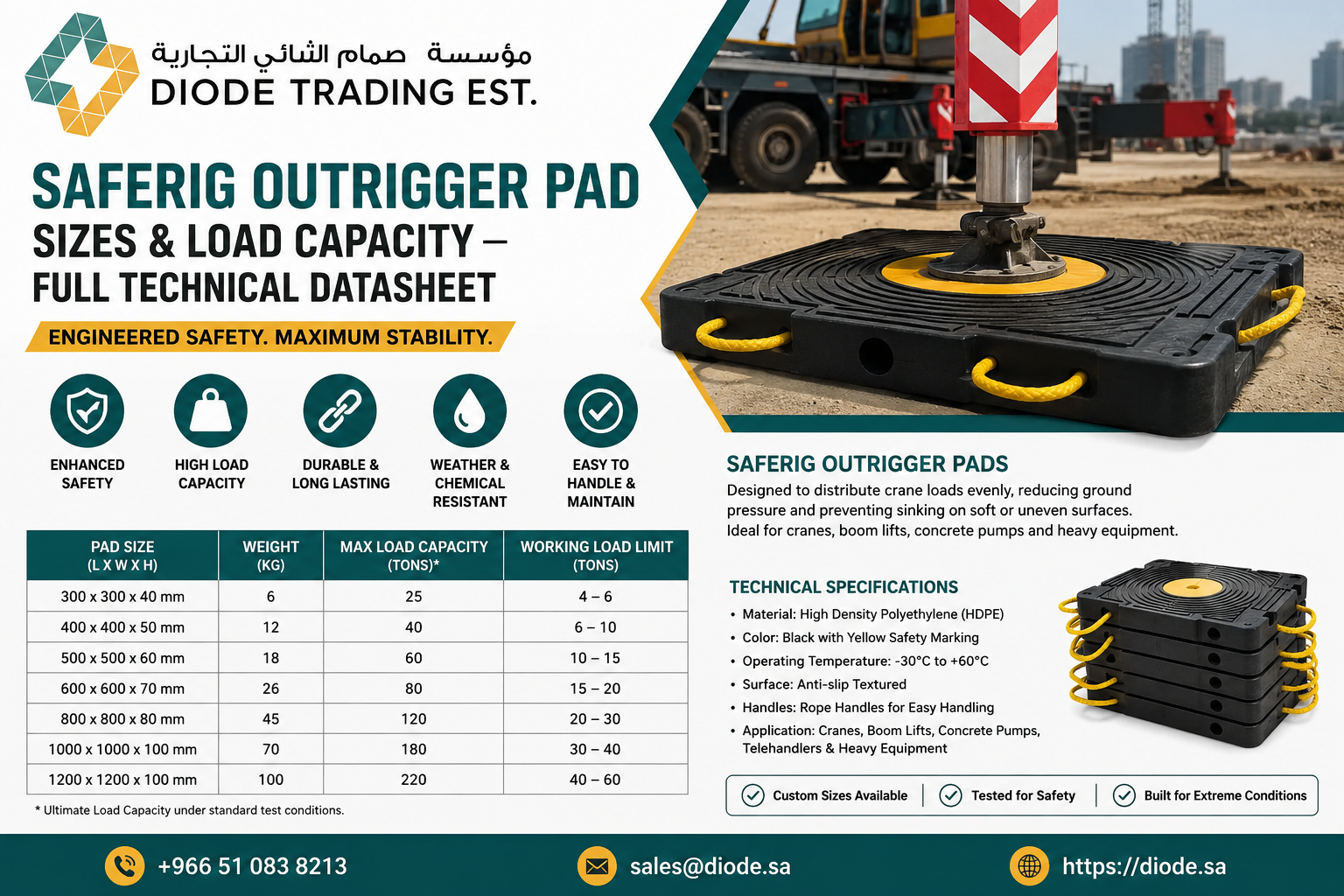
Short answer: outrigger pad thickness controls how stiff the pad is, how well it spreads the load to its edges, and how much load it is rated to carry. A pad that is too thin for its size bends under the outrigger float, so the load concentrates in the middle and the outer area of the pad does little work. Choose the pad area from the ground, then choose the thickness from the leg load and the pad’s rated capacity.
When you size a pad, two separate checks matter:
A large but thin pad can pass the area check on paper and still fail in practice, because it bends and only the central part bears on the ground.
The SafeRig range shows how rated capacity rises with thickness for the same footprint. Figures below are from the SafeRig square pad table:
| Pad size (mm) | Thickness (mm) | Rated capacity (t) | Weight (kg) |
|---|---|---|---|
| 800 × 800 | 50 | 50 | 32 |
| 800 × 800 | 60 | 55 | 38.4 |
| 800 × 800 | 70 | 75 | 44.8 |
| 800 × 800 | 80 | 80 | 51.2 |
| 1000 × 1000 | 50 | 75 | 48 |
| 1000 × 1000 | 60 | 80 | 60 |
| 1000 × 1000 | 70 | 100 | 70 |
| 1000 × 1000 | 80 | 120 | 80 |
| 1000 × 1000 | 100 | 160 | 100 |
| 1200 × 1200 | 60 | 180 | 86.4 |
| 1200 × 1200 | 80 | 220 | 115.2 |
| 1200 × 1200 | 100 | 220 | 144 |
For the full range, from 300 × 300 mm up to 3000 × 1000 mm, see SafeRig outrigger pads.
On soft ground, such as sabkha, wet fill or sand, stiffness matters even more, because the ground offers little support at the pad edges. A thicker pad keeps the load spread over the full area. On sabkha the required area can also exceed a single pad; see sabkha crane outrigger pads.
UHMWPE pads flex slightly under load and recover, rather than cracking like brittle plastics or splitting like dry timber. Steel plates are very stiff but heavy and can slide on smooth surfaces. For a full comparison read steel plate vs plastic outrigger pads and outrigger pads vs timber cribbing.
Not sure which thickness you need? Use our Outrigger Pad Size Calculator, or send us your crane model and ground conditions. For the full selection process see our guide on how to choose outrigger pads.
Not directly. Ground pressure depends on the effective area. But a thicker, stiffer pad keeps the full area working, so it prevents pressure concentrating under the float.
Choose the pad area from the ground conditions, then pick a thickness whose rated capacity is at least the outrigger reaction. SafeRig pads list rated capacity for every size and thickness.
A pad that is thin relative to its size and the load deflects under the float. Repeated overload can leave it permanently bowed.
No. Both have the same area, but the 100 mm pad is stiffer and has a much higher rated capacity (160 t vs 75 t in the SafeRig range).
See our range of high-visibility safety mats and markers designed to reduce trip hazards across your site.
 10 October, 2026 | Admin
Planning a crane lift in Qatar means solvi
Read more