
Enquire Now
Enquire Now

Compare the properties of the engineering plastics we stock side by side. Pick two to five materials to see density, strength, temperature range, friction, water absorption, wear and chemical resistance, dimensional stability and relative cost, with a link to each full datasheet.
Choose 2 to 5 materials to compare
Typical values for common industry grades, taken from our technical datasheets. They are a guide for material selection, not a guarantee. Exact grades are confirmed on quotation with the material test certificate.
Not sure which grade you need? Use Add selected materials to quote and describe your application, or work out sheet and rod weights with the plastic weight calculator. For a detailed written guide, read POM vs nylon vs UHMWPE vs PTFE. See all our engineering plastics, UHMWPE sheets and rods and PTFE products.
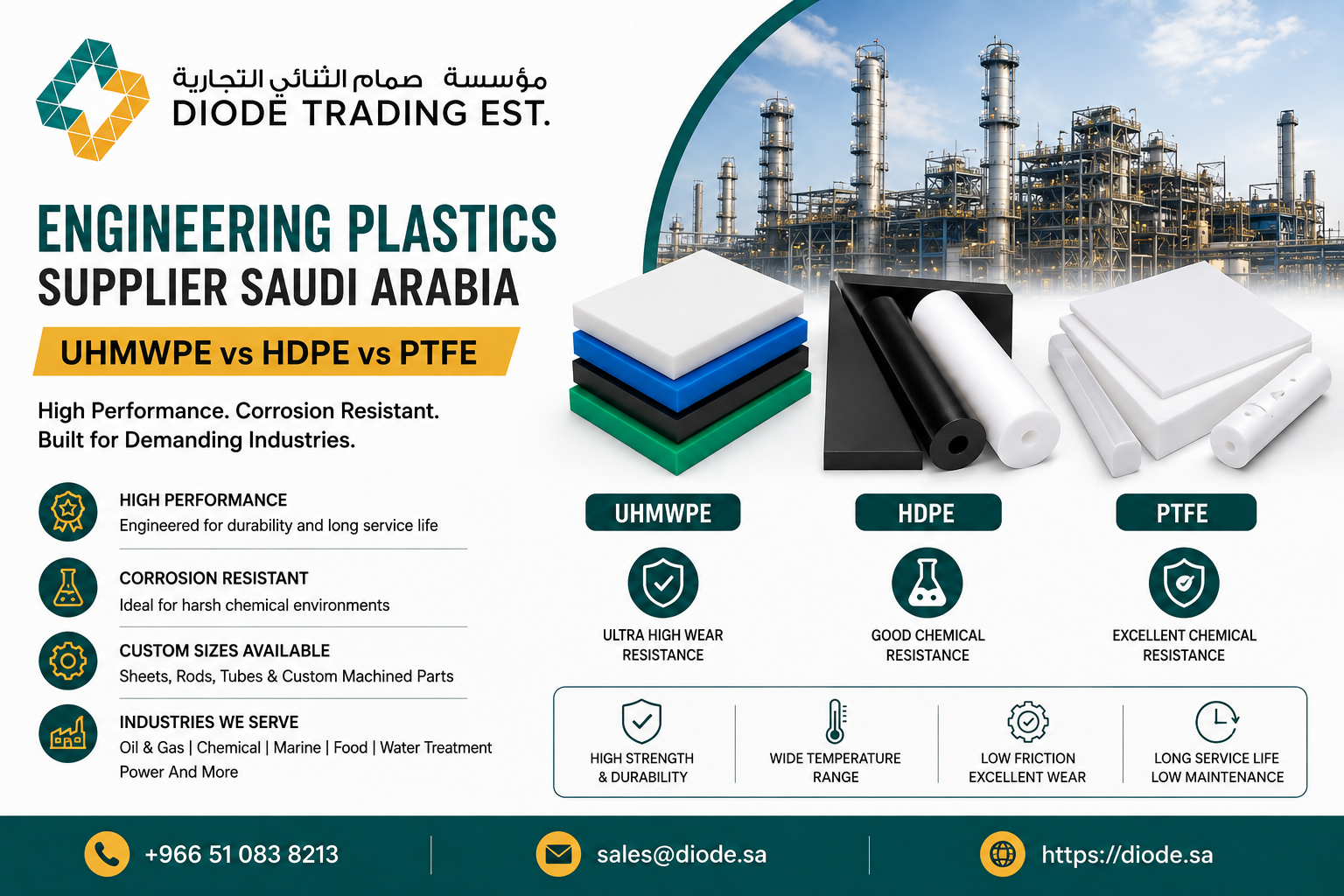
The engineering plastics comparison is most useful when you start from the property that matters most for your part, rather than from the material name. For a wear strip or chute liner, look first at abrasion resistance and friction. For a precision bush or gear, look at dimensional stability and water absorption, because a material that swells with moisture will not hold a tight fit. For a part in a hot or chemical environment, start with the temperature range and chemical resistance, then check strength.
Relative cost matters too. UHMWPE, HDPE and PP are economical choices for large sheets and liners, nylon and POM sit in the middle for machined parts, and PTFE and PEEK cost more but cover duties that the other materials cannot. A side-by-side engineering plastics comparison makes it easier to see when a cheaper material is good enough and when the extra cost of a high-performance grade is justified.
For general background on this group of materials, see this overview of engineering plastics. If two materials look close for your application, add both to your quote and our team will help you decide.
Both are polyethylene, but UHMWPE (PE1000) has a much higher molecular weight. It has far better abrasion and impact resistance and lower friction (0.10–0.20 vs 0.25–0.30 on steel). HDPE (PE300) is cheaper, easier to weld and suits tanks, food surfaces and general fabrication.
Nylon PA6 is tougher and better for shock loads, but it absorbs up to about 9% water, which changes its size. POM absorbs less than 1% and keeps close tolerances, so it is better for precision bushes.
PTFE handles up to about +260 °C continuous and PEEK about +250 °C. UHMWPE and HDPE are limited to about +80 °C.