
Enquire Now
Enquire Now

Use this gasket size chart to find the right ring gasket size for your flange. Choose the flange size (NPS) and pressure class to get the inside and outside diameter in millimetres and inches, then add it to your quote with the material and thickness you need.
Non-metallic flat ring gaskets (raised-face) for ASME B16.5 flanges, NPS ½–24, to ASME B16.21. Tolerances: OD +0/−1.5 mm and ID ±1.5 mm up to NPS 12; OD +0/−3.0 mm and ID ±3.0 mm for NPS 14 and above. Always check against your flange drawing before cutting.
The sizes are for non-metallic flat ring gaskets that fit inside the bolts of raised-face ASME B16.5 flanges, as given in ASME B16.21. The inside diameter is the same for all classes; the outside diameter grows with the pressure class because the bolt circle gets larger.
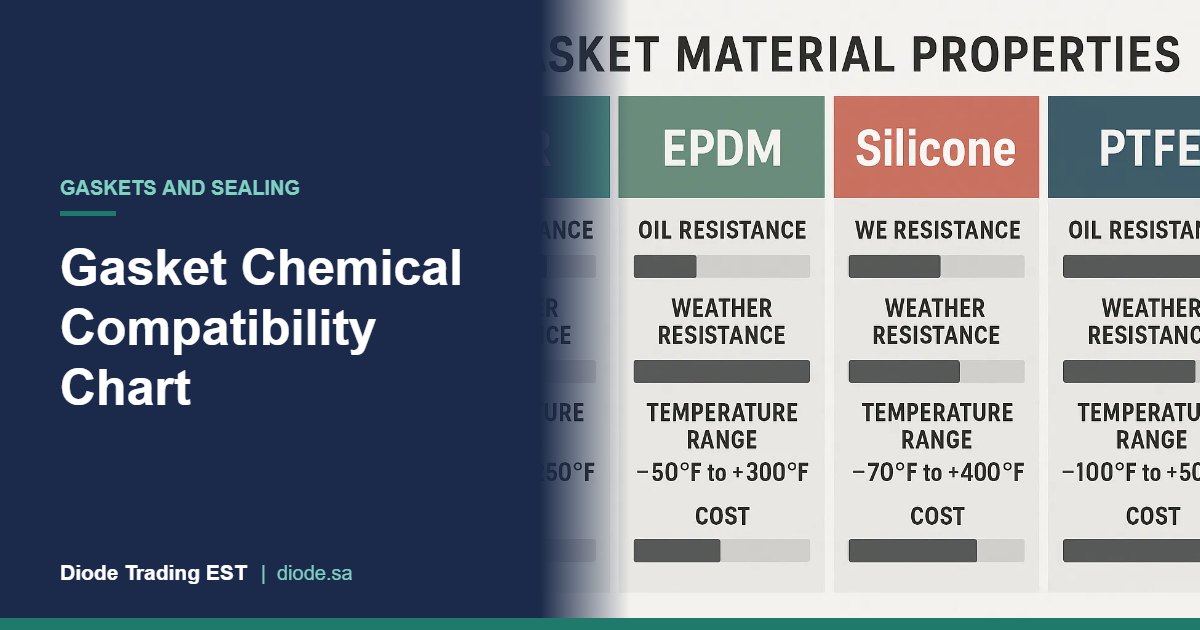
We cut ring and full-face gaskets from CNAF, PTFE, graphite and rubber sheets, including neoprene, EPDM and NBR, in 1.5 mm and 3 mm thickness and other sizes on request. See the gasket chemical compatibility chart to choose a material.
To use the gasket size chart you need two details from the flange: the nominal pipe size (NPS) and the pressure class, such as Class 150 or Class 300. Both are normally stamped on the flange rim. Pick the NPS first, then the class, and the chart gives the inside diameter that matches the pipe bore and the outside diameter that sits just inside the bolts.
A ring gasket of this type, often called an inside bolt circle (IBC) gasket, centres itself on the bolts during assembly. A full-face gasket covers the whole flange face and has the bolt holes cut through it. Full-face gaskets are usually chosen for flat-face flanges, for example on cast iron or plastic equipment, where a ring gasket could let the flange bend as the bolts are tightened.
Thinner gaskets such as 1.5 mm are generally preferred on smooth, well-aligned raised-face flanges, because they creep less and hold bolt load better. Thicker gaskets such as 3 mm tolerate more unevenness or minor damage on the flange face, and soft rubber gaskets are often used thicker for low-pressure water and air service. If you are unsure, tell us the fluid, temperature and pressure and we will suggest a thickness.
For general background on how gaskets seal, see this overview of gaskets.
An ASME B16.21 ring gasket for NPS 2 Class 150 is 60 mm (2.38 in) ID and 105 mm (4.12 in) OD.
Yes. Full-face gaskets with bolt holes are cut to your flange drawing or standard. Add the item to your quote and mention “full face” in the notes.
Stock in Dammam · MTC with every order
Need a price or lead time? Talk to our sales team.