Short answer: HDPE (high-density polyethylene) is a tough, low-cost, chemical-resistant plastic with very low moisture absorption. Sheets and rods are used for tank linings, cutting boards, wear strips, marine parts, fabricated covers and food equipment. HDPE is easy to cut and weld, but it is softer than UHMWPE and has a lower wear life.
This guide covers HDPE sheets and rods. HDPE shims are a different product, and UHMWPE sheets and rods are a different material with higher abrasion resistance.
Key properties
- good resistance to many acids, alkalis and solvents
- tough, with good impact strength even at low temperature
- very low water absorption
- lightweight, with low friction
- food-contact grades available
- can be welded, machined and thermoformed
Limits
- low stiffness compared with engineering plastics
- softens at moderate temperature
- expands and contracts more than metals with temperature
- UV degrades it unless the grade is stabilised
- hard to bond with adhesives; welding is preferred
Colours and grades
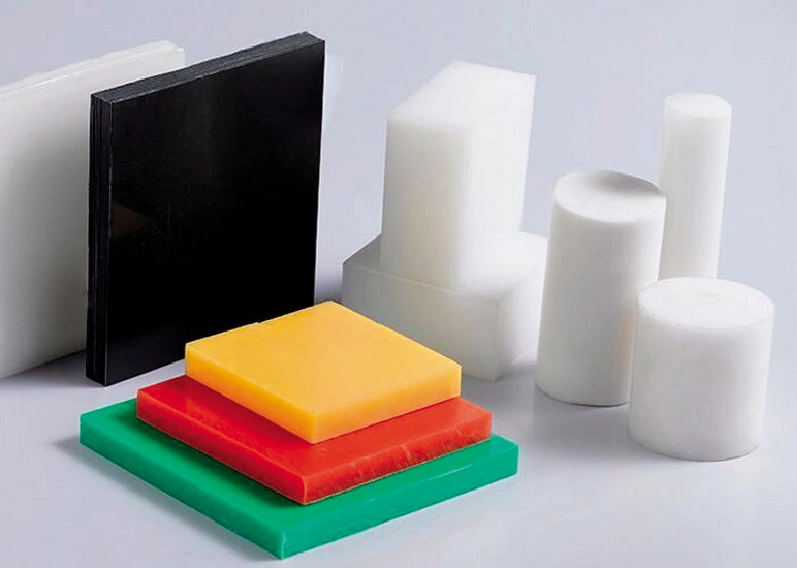
HDPE is sold in natural, black, white and coloured versions. Black UV-stabilised sheet is typical for outdoor and marine use. Coloured and textured versions are used in cutting boards and playground-type applications. If food contact is needed, request a food-contact grade and documentation.
Typical uses
| Application |
Why HDPE |
| Tank and chute liners |
Chemical resistance and low friction |
| Cutting boards |
Hygienic and knife friendly |
| Marine and dock parts |
Water and impact resistance |
| Application |
Why HDPE |
| Wear strips and guides |
Low friction and light weight |
| Fabricated covers and trays |
Easy to cut and weld |
HDPE or UHMWPE?
UHMWPE has a much higher molecular weight, so it resists abrasion and impact better and has lower friction. HDPE is cheaper, easier to weld and thermoform, and is fine for general chemical and light wear use. For heavy sliding wear or abrasive material handling, choose UHMWPE. See UHMWPE guide.
Fabrication tips
HDPE is welded with matching rod. When machining, use sharp tools and avoid overheating. Allow for thermal expansion when fixing large sheets, using slotted holes.
What to send
Thickness, size, colour, food contact or not, application and quantity. Diode Trading EST supplies HDPE sheets and rods in Saudi Arabia, and every order ships with a Material Test Certificate. Request a quote.
Ordering tips
HDPE sheets are usually supplied in standard sizes and can be cut to order. Choose a thickness that allows for machining, and say whether you want the sheet flat and stress-relieved, since thick extruded HDPE can bow slightly after cutting.
Questions to ask your supplier
Is the sheet natural, black or coloured, and is it UV-stabilised? Is a food-contact grade available, and what documents support it? What is the thickness tolerance? Is the sheet extruded or pressed, since pressed sheets are usually flatter and stress-free?
Fabrication tips
HDPE can be welded with matching rod, routed, drilled and thermoformed. Use sharp tools and avoid overheating, which melts the cut edge. Leave expansion gaps when fixing large panels, and use slotted holes rather than tight fixings. For outdoor installations, use black UV-stabilised sheet.
Common mistakes to avoid
- using HDPE where heavy abrasive wear calls for UHMWPE
- fixing sheets tightly without room to expand
- using unprotected natural HDPE in strong sunlight
- expecting adhesives to bond HDPE reliably
HDPE for food and hygiene areas
In food preparation and processing, HDPE is widely used for cutting boards, work surfaces, guides and chute liners, because it is easy to clean and does not absorb moisture. Colour coding is common, with different colours assigned to different food types to reduce cross-contamination. If food contact is needed, ask for a food-contact grade and its documentation.
For general product standards in the Kingdom, see the Saudi Standards, Metrology and Quality Organization (SASO).
Frequently asked questions
What is HDPE sheet used for?
Liners, cutting boards, marine parts, wear strips and fabricated parts.
Is HDPE food safe?
Food-contact grades are. Ask for documentation.
Can HDPE be welded?
Yes, with HDPE rod.
HDPE or UHMWPE?
UHMWPE is better for abrasion. HDPE is cheaper and easier to fabricate.
Related guides: UHMWPE Sheets and Rods · Polypropylene Sheets · Cutting Boards
Explore the product range: HDPE High Density Polyethylene Sheets Rods
Need a price or lead time? Request a quote with sizes, quantity and delivery city in Saudi Arabia.
See also: HDPE sheets and rods in stock in Saudi Arabia



 03 November, 2026 |
 Admin