

 30 October, 2026 |
 Admin
Synthetic Turf in Saudi Arabia
Short answer: Synthetic t
Read more
Enquire Now
 30 October, 2026 | Admin
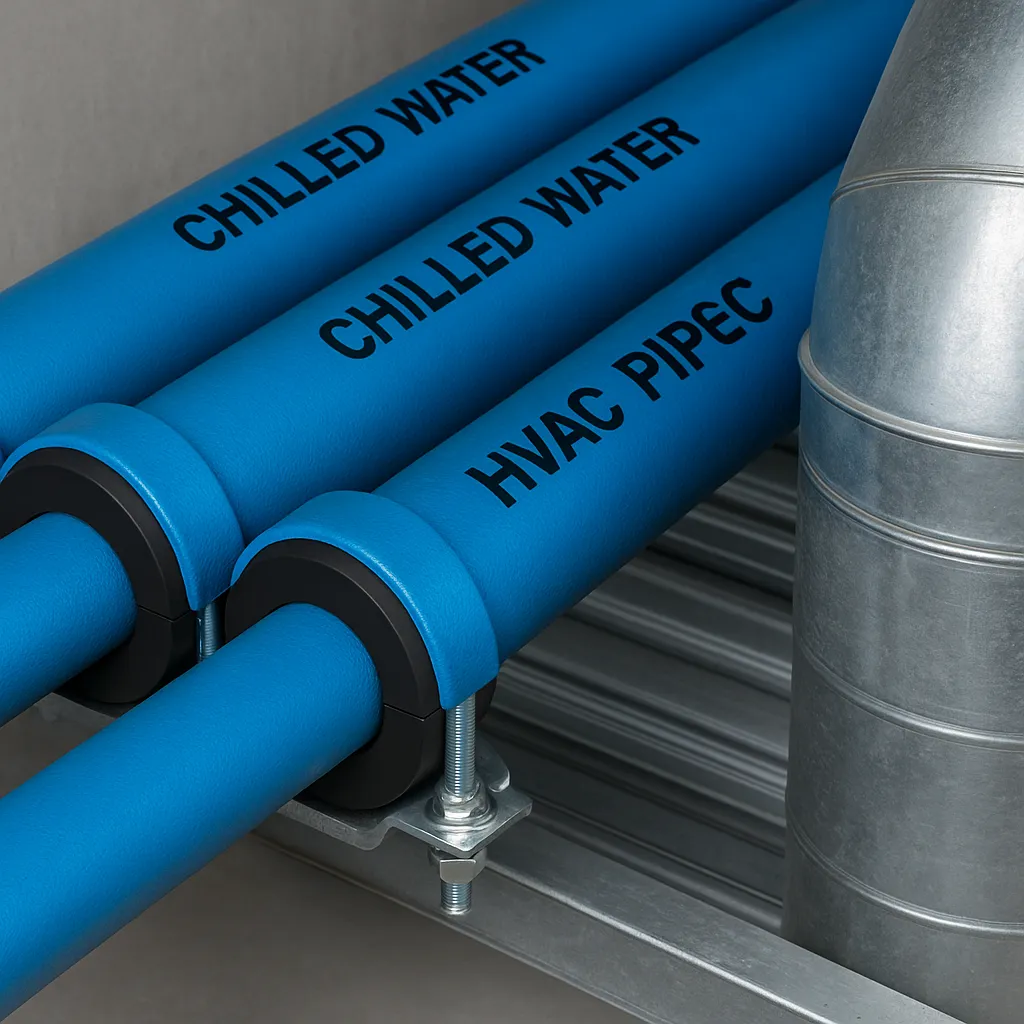
Short answer: A rubber support insert sits between a
pipe and its clamp or hanger. In chilled water and HVAC systems it stops
metal-to-metal contact, reduces vibration and noise, and helps prevent
thermal bridging that causes condensation and heat gain. Choose the
insert size by the pipe diameter and insulation thickness, and the
rubber for the temperature and environment.
Chilled water pipes are cold and are normally insulated to prevent
condensation. But where a bare metal clamp touches the pipe, it creates
a cold path (a thermal bridge) through the insulation. Moisture forms
there, which leads to corrosion and dripping. Pumps and chillers also
send vibration through the pipe into the structure. A rubber insert
breaks the metal contact, lowers vibration transmission and helps keep
the insulation continuous.
Inserts are usually curved blocks or strips matching the pipe curve,
sometimes with a core or sleeve. They sit inside the support so the pipe
rests on rubber, and the insulation is protected. Different products are
used for pipes with or without outer insulation, so check the
arrangement used on your project.
Choose the compound for the working temperature range and the
environment. Chilled water systems run cold, and some installations are
in rooftop sun, so weather resistance matters.
Fit the insert so it fully supports the pipe and sits inside the
clamp, with no gaps. Do not over-tighten the clamp, which compresses and
damages the insert. Keep insulation vapour barriers continuous around
the support. Check inserts at handover and in routine maintenance for
compression set, damage and condensation.
What sizes and thicknesses are available? What rubber is used and
what is its temperature range? Is the product suited to outdoor use? Can
sizes be supplied to match the project schedule? What documents are
available?
Diode Trading EST supplies rubber products across Saudi Arabia, and
every order ships with a Material Test Certificate. request a quote
For heavy pipe loads, ask whether the support design needs a
higher-strength insert or a different arrangement, such as a rigid
insulated support block. For rooftop pipes in strong sun, choose
weather-resistant compounds. If you are unsure which support the
consultant specified, send the support drawing and we will check the
insert against it.
At handover, confirm that every support on the chilled water line has
its insert, that the insulation vapour barrier is continuous through
each clamp, and that no bare metal touches the pipe. Take photos of
typical supports for the record.
Why use rubber inserts on chilled water pipes? To
stop thermal bridging and reduce vibration.
Do inserts prevent condensation? They help by
breaking the cold path through the clamp.
Which rubber is best? EPDM or neoprene, depending on
the conditions and specification.
Can inserts be supplied for different pipe sizes?
Send the sizes and quantities.
Related: Neoprene Rubber Sheet · EPDM Beading ·
Rubber Sheets Guide
See our range of high-visibility safety mats and markers designed to reduce trip hazards across your site.


Diode Trading EST supplies these Rubber Sheets, Gaskets & Seals from stock in Dammam, with delivery across Saudi Arabia and the GCC.