

 12 September, 2026 |
  Admin
Admin
Introducing Saferig — Diode
Saferig is Diode Trading EST's outrigger pad
Read more
 28 August, 2026 | Admin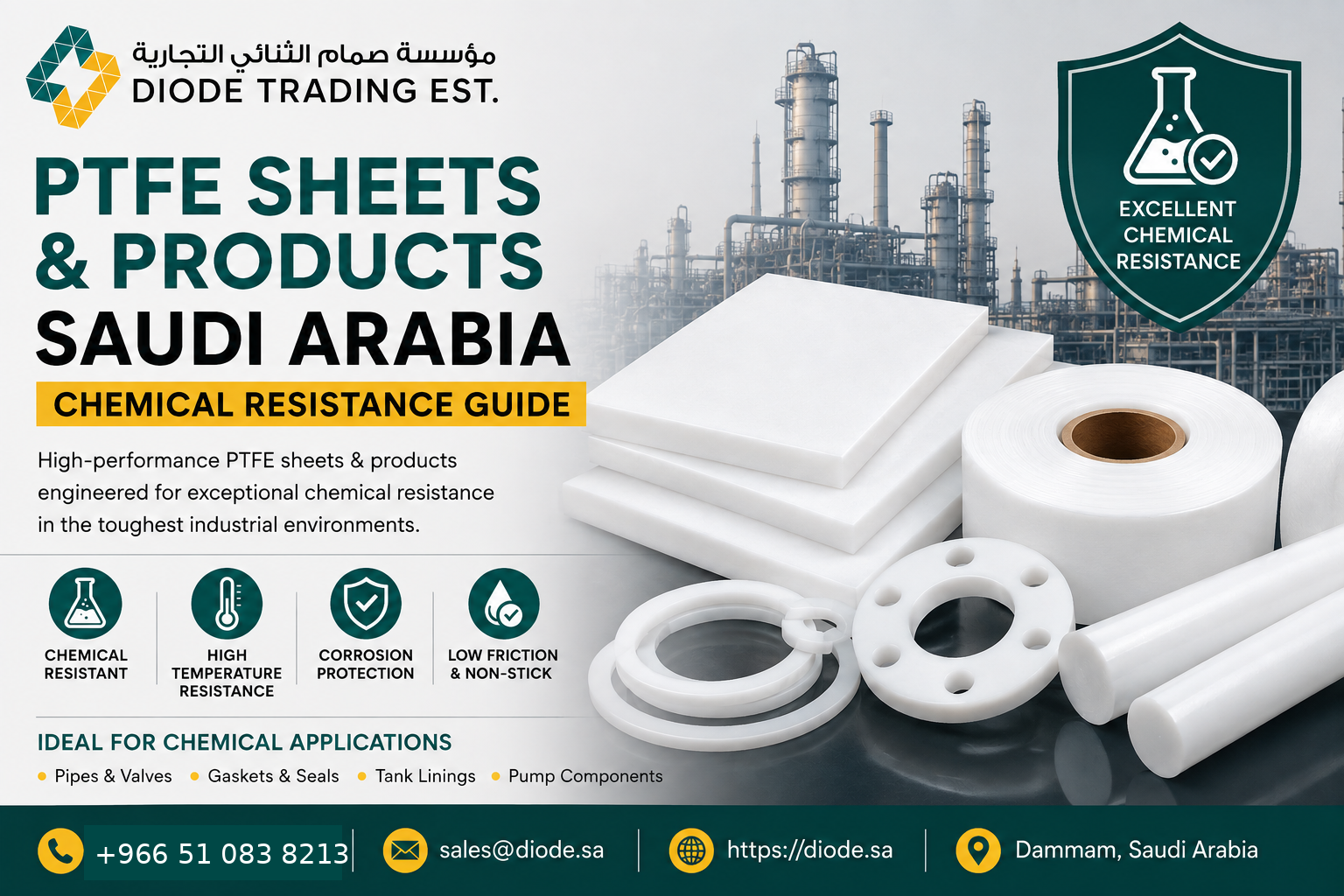
PTFE sheets Saudi Arabia buyers reach for when a material has to barely react with anything. PTFE — you might know it by the brand name Teflon — shrugs off acids, solvents, and most chemicals a plant will throw at it, which is why it shows up everywhere from gasket faces to pipe lining across PTFE Products Saudi Arabia’s refineries and chemical plants.
Virgin PTFE and filled PTFE behave differently under load and temperature. Tell us the operating conditions and we’ll point you to the right grade rather than the cheapest one.
Virgin PTFE sheet gives the purest chemical resistance and the lowest friction, which makes it the default choice for gaskets and linings in aggressive chemical service. Filled PTFE, blended with glass fiber, carbon, or bronze, trades a little chemical purity for better creep resistance and load-bearing capability, which matters in gaskets under sustained bolt load or bearing and seal applications that see continuous mechanical stress.
PTFE sheet handles continuous service across an unusually wide temperature range, from cryogenic conditions up to roughly 260°C, without losing its chemical resistance — a stability profile documented in PubChem’s material data for polytetrafluoroethylene. Its main mechanical weakness is cold flow under sustained pressure, so gasket designs typically use envelope or spiral-wound configurations rather than relying on flat PTFE sheet alone to hold a high bolt load indefinitely.
Rubber gaskets remain the better choice for many general water, air, and low-temperature service lines, since they seal at lower bolt torque and cost less per gasket. PTFE earns its higher price where the process fluid would attack rubber outright — strong acids, caustics, solvents, and many oxidizers. Our separate guide to rubber gasket selection covers how to pick the right elastomer compound for the services where PTFE isn’t actually necessary.
A correctly specified PTFE gasket still fails early if it’s installed poorly: under-torqued bolts allow the joint to leak under pressure cycling, while over-torquing can cause the gasket to cold-flow out of the flange face faster than normal. Flange face condition matters too — pitting, scratches, or old gasket residue left on the sealing surface all create leak paths a new gasket cannot compensate for. We cover these and other causes in more detail in our guide to industrial seal failure causes.
Refineries, petrochemical plants, and desalination facilities across the Kingdom specify PTFE sheet and gaskets wherever process fluids would degrade rubber or standard elastomer seals within weeks. Our stock covers standard sheet thicknesses for gasket cutting as well as PTFE-lined pipe sections for lines carrying strong acids or highly corrosive process chemicals.
PTFE sheet is chemically stable but still needs reasonable care in storage. Keep sheet stock flat and out of direct sun where possible, since prolonged UV and heat exposure of stacked sheet can cause slight surface changes over long periods, and avoid dragging sheet across abrasive floors before cutting, since surface scratches can become the starting point for a gasket leak once installed. Cut gaskets should be stored flat as well, not rolled or folded, until they’re ready to install.
For PTFE sheets Saudi Arabia orders, send us the fluid, pressure, temperature, and flange or fitting size, and we’ll confirm the correct PTFE grade, thickness, and lead time. For lined pipe sections and custom gasket cutting, a drawing or existing part sample speeds up the quote significantly.

See our range of high-visibility safety mats and markers designed to reduce trip hazards across your site.
 12 September, 2026 | Admin
Saferig is Diode Trading EST's outrigger pad
Read more 12 September, 2026 | Admin
Timber cribbing was the default for decades.
Read more