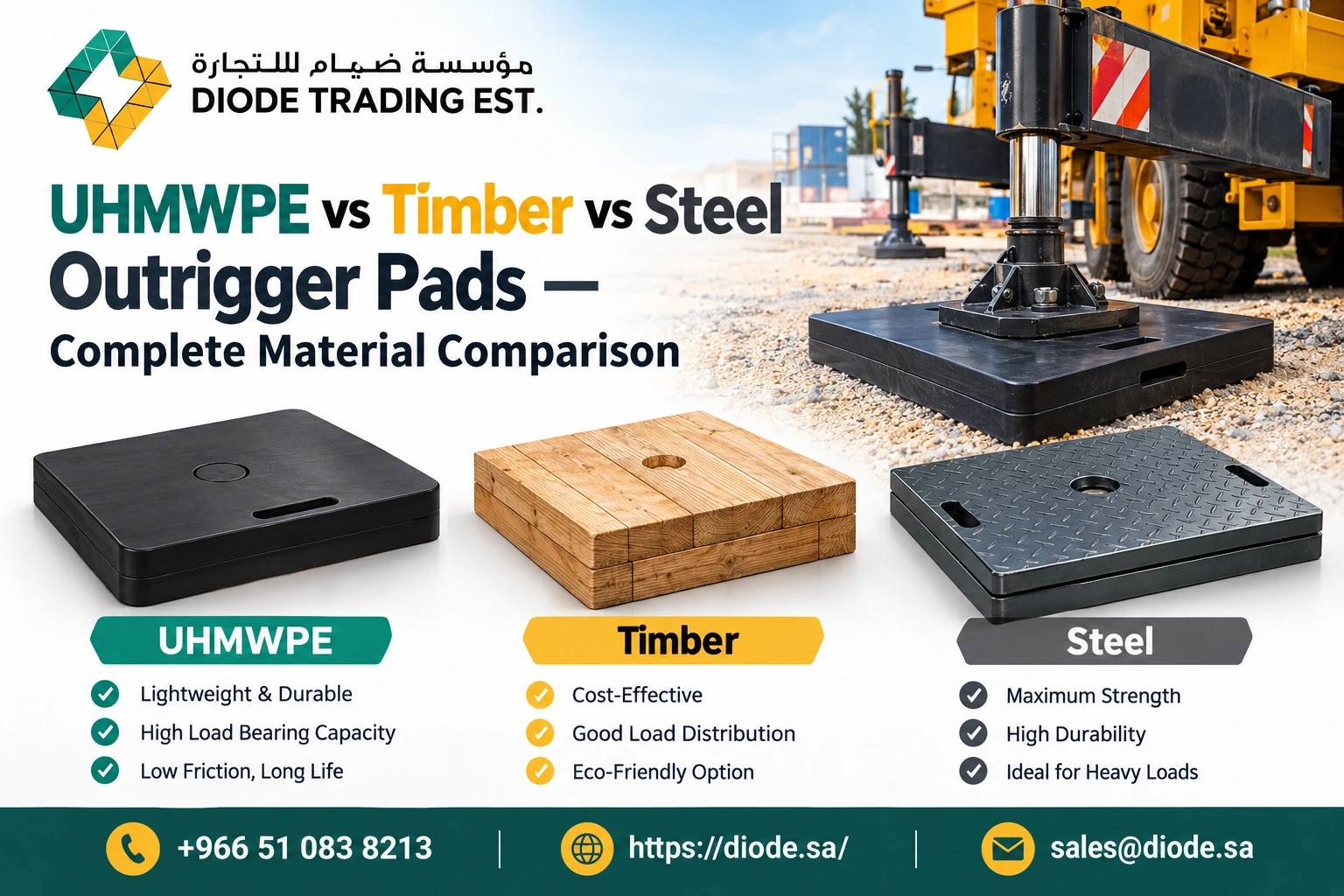
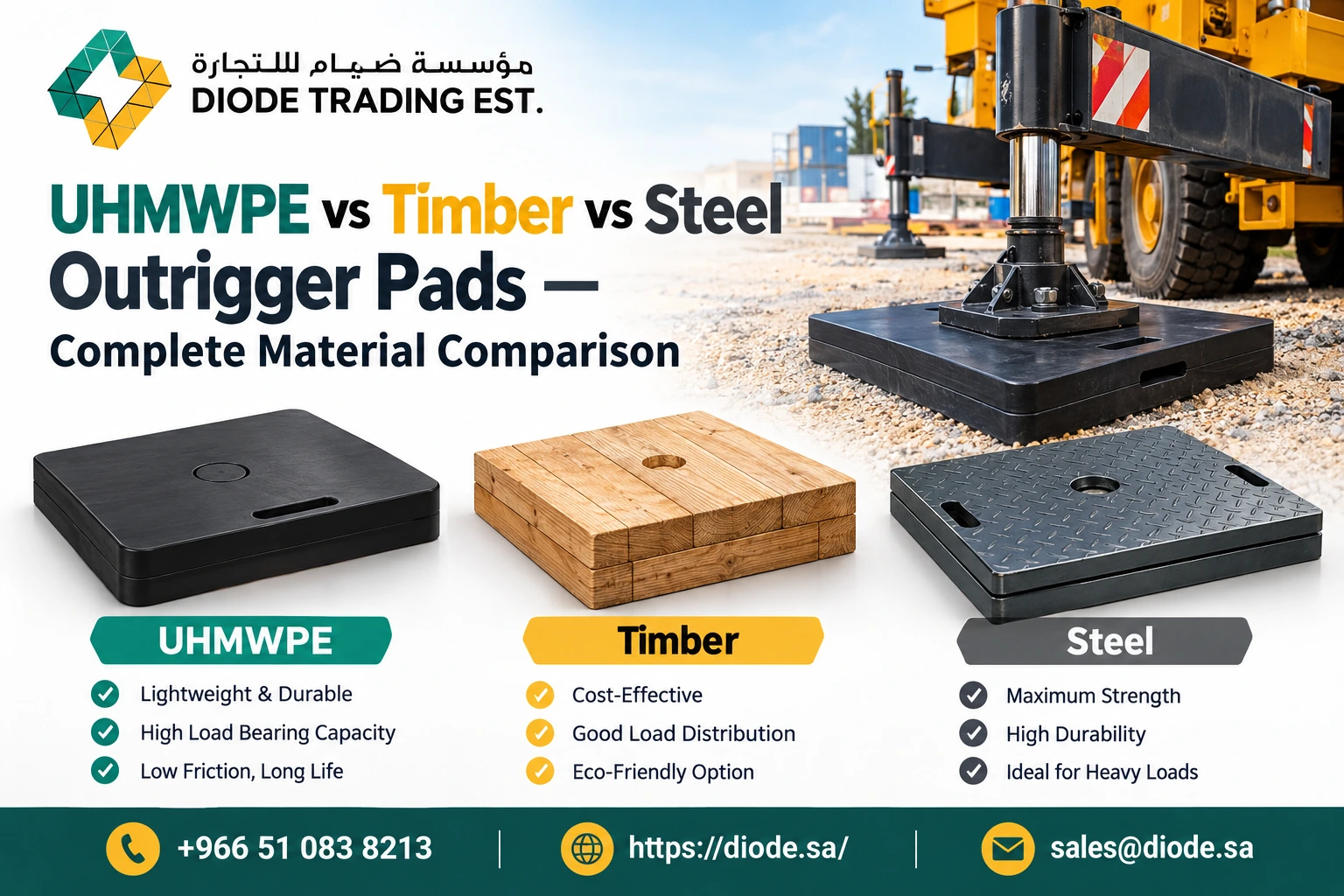
UHMWPE vs Timber Vs Steel Outrigger Pads: Three materials dominate the outrigger pad market: UHMWPE (a high-performance plastic), timber, and steel. Each has a genuinely different profile, and the right choice depends on how often you’ll use the pad, what it’ll be exposed to, and how much weight you’re willing to carry.
Quick Comparison
| Factor |
UHMWPE |
Timber |
Steel |
| Weight |
Light |
Heavy |
Very heavy |
| Upfront cost |
Moderate-high |
Low |
High |
| Lifetime cost (repeat use) |
Low |
High (frequent replacement) |
Moderate |
| Heat resistance |
Excellent |
Poor — dries, cracks, splits |
Excellent |
| Chemical/moisture resistance |
Excellent |
Poor |
Good, but corrodes over time |
| Load capacity per unit weight |
Very good |
Fair |
Excellent |
| Handling/setup speed |
Fast — single piece, light |
Slow — often stacked/cribbed |
Slow — heavy, needs equipment to move |
| Typical lifespan (repeat commercial use) |
Years, minimal degradation |
One season or less in harsh heat |
Long, if corrosion is managed |
UHMWPE — Ultra-High-Molecular-Weight Polyethylene
UHMWPE has become the default choice for commercial outrigger pad use, and the reasons are mostly about total cost of ownership rather than upfront price. It resists heat, chemicals, and UV exposure far better than timber, doesn’t corrode like steel, and is light enough that one person can carry and position a mid-size pad without equipment.
Where UHMWPE wins:
- Repeat commercial use across multiple projects — the material simply lasts longer under repeated loading and sun exposure
- Hot climates — UHMWPE retains its structural properties across the full range of summer surface temperatures that would soften lower-grade plastics
- Sites requiring documentation — Material Test Certificates are standard with quality UHMWPE pads, which matters for Aramco/SABIC-style site requirements
Where it’s a weaker fit:
- Extremely short-term, one-off use where upfront cost matters more than longevity
Timber
Timber cribbing was the traditional default for decades, and it’s still in use — mainly because it’s cheap and universally available. The tradeoff is durability: timber dries and splits under sustained heat, absorbs water and swells, and degrades faster under repeated loading than either UHMWPE or steel.
Where timber wins:
- Very short-term or one-off jobs where the pad won’t see repeat use
- Low-budget projects where upfront cost is the primary constraint
Where it’s a weaker fit:
- Hot climates — direct summer sun exposure accelerates splitting and warping significantly
- Repeat commercial use — the total cost of constantly replacing degraded timber often exceeds a UHMWPE pad’s higher upfront cost within a year or two
Steel
Steel plates offer the highest load capacity per unit area of the three materials, which makes them relevant for very heavy, concentrated loads. The tradeoffs are weight — steel plates typically need mechanical equipment just to move and position — and long-term corrosion risk, particularly in coastal or humid environments.
Where steel wins:
- Very heavy point loads that exceed what a reasonably-sized UHMWPE pad can rate for
- Permanent or semi-permanent installations where weight and handling aren’t a concern
Where it’s a weaker fit:
- Frequent repositioning — the weight makes handling slow and often requires additional equipment
- Coastal or humid sites — corrosion becomes a genuine long-term maintenance issue
Steel plate vs UHMWPE pad, side by side
| Factor |
Steel plate |
UHMWPE pad |
| Weight |
Very heavy; often needs a forklift or the crane itself |
Light; smaller pads carried by hand |
| Stiffness |
Very high for its thickness |
Lower; needs more thickness for the same load spread |
| Corrosion |
Rusts on coastal and sabkha sites unless painted |
Does not corrode |
| Slip |
Smooth plate can slide on wet or smooth surfaces |
Textured and anti-slip surfaces available |
| Chemicals and fuel |
Resistant but rusts |
Resists hydraulic oil, diesel and most site chemicals |
| Surface damage |
Edges cut into asphalt and finished surfaces |
Gentler on finished surfaces |
| Electrical |
Conductive |
Non-conductive |
| Service life |
Long if maintained and painted |
Long; does not rot, rust or split |
When a steel plate still makes sense
- Very high point loads where a thin, very stiff plate is needed under a small float.
- Semi-permanent set-ups where the plate is placed once and left.
- Where an engineered lift plan specifies steel.
When UHMWPE is the better choice
- Mobile cranes, truck cranes, boom trucks and concrete pumps that set up daily.
- Coastal, humid or chemical environments.
- Sites where finished surfaces must be protected.
- Work near live electrical equipment, where a non-conductive pad is preferred.
Handling is where the difference is largest: a steel plate sized for a mid-size crane can weigh several hundred kilograms, and manual-handling injuries are common when plates are dragged into position. A UHMWPE pad of similar area is a fraction of the weight. See our safe use of outrigger pads and outrigger pad thickness guides.
Decision Framework
1. If you’ll use the pad repeatedly across multiple projects, in a hot climate, and need documentation: UHMWPE.
2. If it’s a genuinely one-off job with a tight budget and no repeat use planned: timber can be acceptable.
3. If your load exceeds what a practical UHMWPE pad size can rate for, or the installation is semi-permanent: steel.
FAQ
1. Is UHMWPE actually more cost-effective than timber long-term?
For contractors using ground protection repeatedly across multiple jobs, UHMWPE typically works out more cost-effective over time due to its much longer service life, even though the upfront cost per unit is higher than timber.
2. Can steel outrigger pads rust and become unsafe?
Yes, uncoated or poorly maintained steel plates can corrode over time, particularly in coastal or humid environments, which can affect structural integrity. Regular inspection is important for any steel pad in continuous or semi-permanent use.
3. Which material is lightest for manual handling?
UHMWPE is significantly lighter than steel for a comparable load rating, and generally comparable to or lighter than timber, making it the easiest of the three to handle without mechanical assistance.
UHMWPE vs Timber Vs Steel Outrigger Pads: Next Steps
For UHMWPE vs timber vs steel outrigger pads questions, product data or a quotation, contact Diode Trading EST at sales@diode.sa or browse our product range. Every order ships with a Material Test Certificate, and our quality system is certified to ISO 9001.
Need advice on UHMWPE vs timber vs steel outrigger pads? Contact our team at sales@diode.sa for product data and a quotation.



 13 November, 2026 |
 Admin