Short answer: HDPE cutting boards are hygienic, durable and kind to knives. They do not absorb moisture or odours, they are easy to clean and they can be colour-coded to prevent cross-contamination. For commercial kitchens, choose a thickness that resists warping, a colour system that matches your food safety plan and a food-contact grade.
Why HDPE for food preparation
High-density polyethylene is non-porous, so it does not soak up juices and does not harbour bacteria the way wood can when it is cracked and damp. It can be washed in hot water and detergent, and many boards tolerate dishwashers or sanitising. It is tough enough to stand heavy knife work and soft enough not to blunt the knives quickly. It is also lightweight and does not splinter.
Colour coding
Food businesses use different colours for different food types to prevent cross-contamination. A common approach assigns red to raw meat, blue to raw fish, yellow to cooked meat, green to vegetables and fruit, white to dairy and bakery and brown to root vegetables. Your food safety plan may use a different scheme, so follow your own system or the requirements of your inspector. Whichever scheme you use, keep boards separate, and label or mark them clearly.
Thickness and size
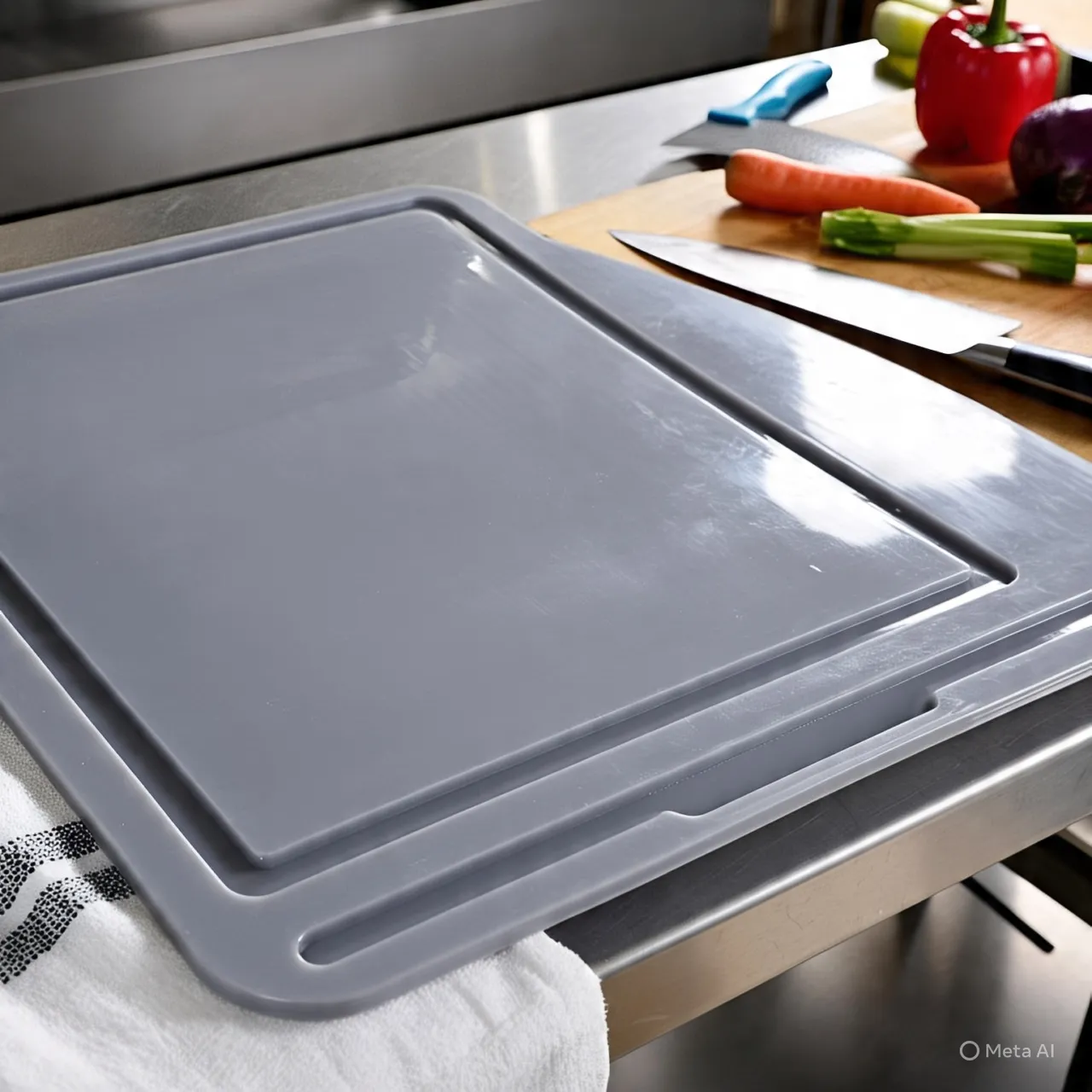
Thicker boards stay flat and last longer under heavy use, while thin boards are lighter for light prep. Choose a board big enough to work without food falling off the edges, and consider extra-large boards for butchery or bakery. Some boards have grooves to catch juices, and some have non-slip feet or are used on a damp cloth to stay in place.
Maintenance
- Wash after each use with hot water and detergent, and sanitise as per your procedure.
- Scrub deep cut marks with a stiff brush; replace boards when cuts get deep and hard to clean.
- Let the board dry fully, standing it upright so air circulates.
- Do not leave boards in strong sunlight or near heat, which can warp them.
- Resurface or replace heavily scored boards.
Other food-safe materials in a commercial kitchen
Food-contact rules increasingly require documented, certified materials, and auditors check the paper trail as closely as the material. HDPE boards are one part of the picture; these are the other food-grade materials a kitchen or food plant usually specifies, all available from Diode with a Material Test Certificate:
- UHMWPE: cutting surfaces, conveyor guides and wear strips; non-absorbent, low friction and easy to clean.
- Food-grade silicone: baking mats, moulds, gaskets and tubing; heat resistant and non-reactive.
- PTFE-coated fabrics: non-stick belts and release sheets for bakeries; high heat resistance.
- Food-grade rubber sheet (white NBR, EPDM, neoprene): seals, gaskets and conveyor contact surfaces that resist fats and oils.
- Stainless steel 304/316: benches, tanks and machinery frames that must be sanitised daily.
Before approving any supplier, confirm the food-contact declaration and traceability documents for the exact grade, and cross-check them against recognised guidance such as the FDA food-contact substance rules, rather than relying on the datasheet alone.
Common mistakes to avoid
- using the same board for raw and cooked foods
- continuing to use a deeply scored board
- stacking boards while damp
- exposing boards to high heat
- buying boards without checking that the HDPE is food-contact grade
Questions to ask your supplier
Is the material food-contact grade, and what documents are available? What thicknesses, sizes and colours are available? Can boards be cut to a custom size? Are boards available with grooves or textured surfaces? Is a sanding or resurfacing service possible?
Diode Trading EST supplies HDPE products across Saudi Arabia, and every order ships with a Material Test Certificate. Request a quote.
Sizing for your kitchen
Match boards to the work: large boards for butchery and bakery, medium boards for general prep and small boards for bar and garnish work. Keep spare boards of each colour so one can be washed while another is in use. For busy kitchens, a rack that stores boards upright and apart helps them dry properly. Share your kitchen layout and the number of stations, and we can suggest a set.
Getting a quotation
Send a short brief with your sizes, quantity, and delivery location in Saudi Arabia, and we will reply with availability, lead time and a quotation. If you are unsure of the right grade, describe the working conditions and we will help you choose.
Frequently asked questions
Are HDPE cutting boards food-safe?
Food-contact grades are. Ask for documentation.
Do HDPE boards blunt knives?
Less than glass or stone, and they are gentle on edges.
How often should boards be replaced?
When cuts become deep and difficult to clean.
Can HDPE boards go in the dishwasher?
Many can. Check the product details.
Related guides: HDPE Sheets and Rods · Polypropylene Sheets · Engineering Plastics Guide
Explore the product range: Cutting Boards
Need a price or lead time? Request a quote with sizes, quantity and delivery city in Saudi Arabia.
See also: HDPE sheets and rods in stock in Saudi Arabia


 13 November, 2026 |
 Admin