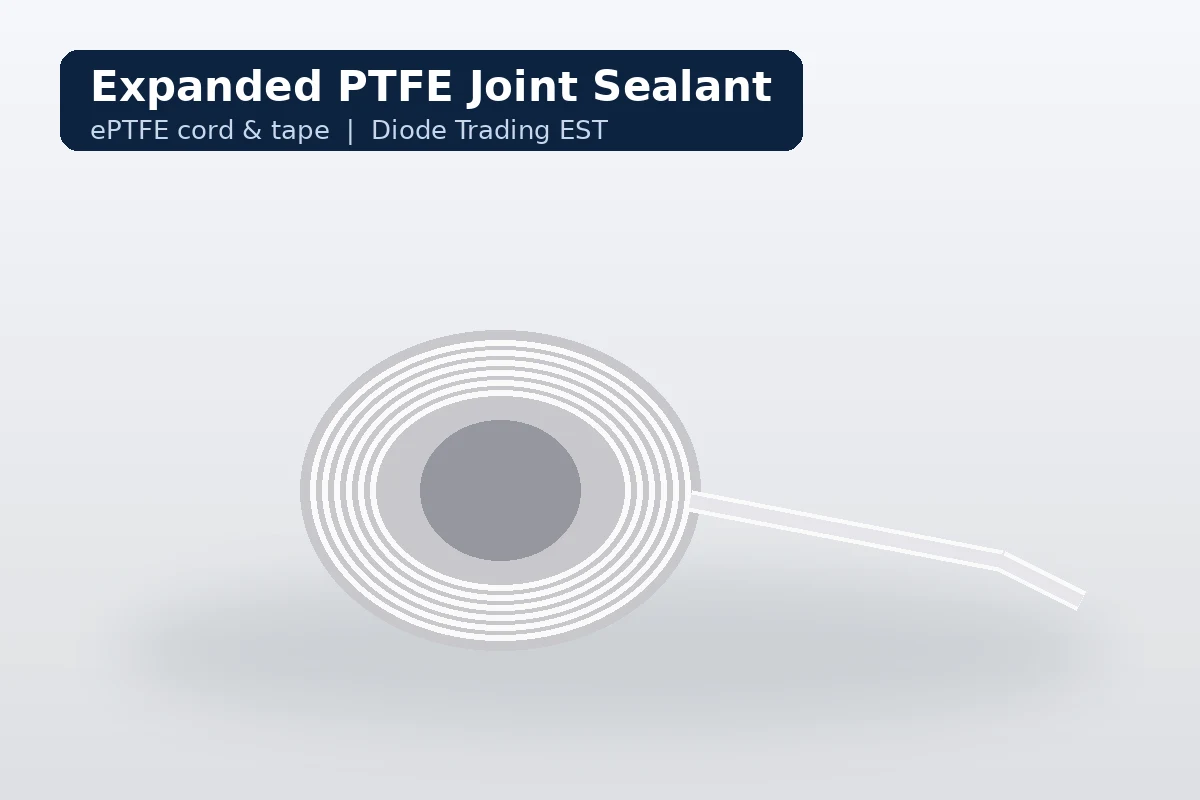
Short answer: Expanded PTFE joint sealant is a soft, porous PTFE cord or tape, usually with an adhesive backing, that is pressed onto a flange or surface and compresses into a gasket. It seals uneven, large or fragile flanges and is useful when a cut gasket is impractical.
Some flanges are too big, too irregular or too delicate for a normal cut gasket. Glass-lined vessels, large manways, ducts and damaged flanges are examples. Expanded PTFE cord solves these by conforming to the surface.
Why it works
Expanded PTFE is stretched into a fibrous, porous structure. It is very soft and compressible, but it keeps PTFE’s chemical resistance. When compressed between flanges, it flows into surface irregularities and seals at relatively low bolt load.
Typical uses
- glass-lined and plastic-lined equipment
- large flanges and manways
- ducts and filters
- chemical, food and pharmaceutical equipment
- emergency or fast repairs where there is no time to cut a gasket
Sizing the cord
The cord should be a little larger than the gap it will fill, because it compresses. The supplier can advise the starting width and thickness from your flange details. Give them:
- flange type, material and surface condition
- bolt hole layout and bolt size
- gap or groove width
- medium and temperature
Installation steps
- Clean the flange faces and remove old gasket residue.
- Position the cord on the face, inside the bolt circle.
- Overlap or join the ends as recommended, avoiding gaps.
- Bring the flanges together and tighten the bolts evenly in stages.
- Check for leaks after the first heating and cooling cycle.
Do not stretch the cord when applying, since that thins it.
Advantages and limits
Advantages: chemical resistance, conformability, no cutting tools needed and low bolt load. Limits: not for very high-pressure or high-load flanges, and not a replacement for a metallic gasket in severe service.
What to send
Flange details, medium, temperature, and length required. Every order from Diode Trading EST ships with a Material Test Certificate. Request a quote.
Where it beats a cut gasket
A cut gasket needs a template, a gasket sheet and time. For a large or odd-shaped flange, a cut gasket can need joins that leak. A continuous cord has fewer joins and can be laid straight onto the flange, which is useful in a shutdown with little time. For damaged or fragile flanges, such as glass-lined vessels, the soft cord protects the surface and seals at low bolt load.
Storage and shelf life
Keep the cord in its box or roll, away from dust and direct heat. If it has an adhesive backing, keep the backing paper on until use. Use clean, dry hands or gloves so oil does not affect the adhesive.
Common mistakes to avoid
- using a cord that is too thin so it is crushed flat and does not fill the gap
- stretching the cord while laying it, which thins it unevenly
- leaving a gap at the joint of the ends
- tightening all bolts on one side first instead of evenly in a cross pattern
Getting a quotation
Send a short brief with your sizes, quantity, and delivery location in Saudi Arabia, and we will reply with availability, lead time and a quotation. If you are unsure of the right grade, describe the working conditions and we will help you choose.
For general product standards in the Kingdom, see the Saudi Standards, Metrology and Quality Organization (SASO).
Frequently asked questions
What is expanded PTFE joint sealant?
A soft PTFE cord or tape that forms a gasket when compressed.
Can it seal glass-lined flanges?
Yes. Its softness helps protect fragile surfaces.
Does it come with adhesive?
Many types do. Ask for the version you need.
Can it be reused?
No. Replace it each time the joint is opened.
Related guides: PTFE Envelope Gaskets · PTFE Gasket Types · PTFE Gland Packing
Explore the product range: Expanded PTFE Joint Sealant Cord
Need a price or lead time? Request a quote with sizes, quantity and delivery city in Saudi Arabia.
See also: What is PTFE? Full form, meaning, properties and uses







 03 November, 2026 |
 Admin