


Technical Specification
Overview
Diode Trading EST supplies neoprene (polychloroprene) bearing pads to bridge, precast, structural and industrial projects across the Kingdom. We supply plain, fabric-reinforced and steel-laminated pads, cut to your bearing schedule and delivered from our Dammam warehouse to Riyadh, Jeddah, Al Khobar, Jubail, NEOM, the Red Sea and every other project site in KSA.
Every order ships with a Material Test Certificate (MTC), so your submittal can show what was actually supplied. Quality, environmental and safety management: ISO 9001, ISO 14001, ISO 45001.
Technical Specifications
| Property | Specification |
|---|---|
| Material | Neoprene (polychloroprene) |
| Governing standard | AASHTO M251 / ASTM D2000 (project specification governs) |
| Hardness | Shore A 50, 60 or 70 (60 is the most commonly specified) |
| Tensile strength | 15.5 MPa minimum (AASHTO M251 requirement) |
| Elongation at break | Per hardness grade (350% minimum for Shore A 60) |
| Compression set | 25% maximum (ASTM D395, Method B) |
| Ozone resistance | Tested to ASTM D1149 |
| Operating temperature | Approx. −30°C to +100°C |
| Size and thickness | Custom to your drawing or bearing schedule |
| Documentation | Material Test Certificate with every order; datasheet on request |
Typical values for the standard grade. The Material Test Certificate supplied with your batch is the controlling document, and we match the grade to your project specification.
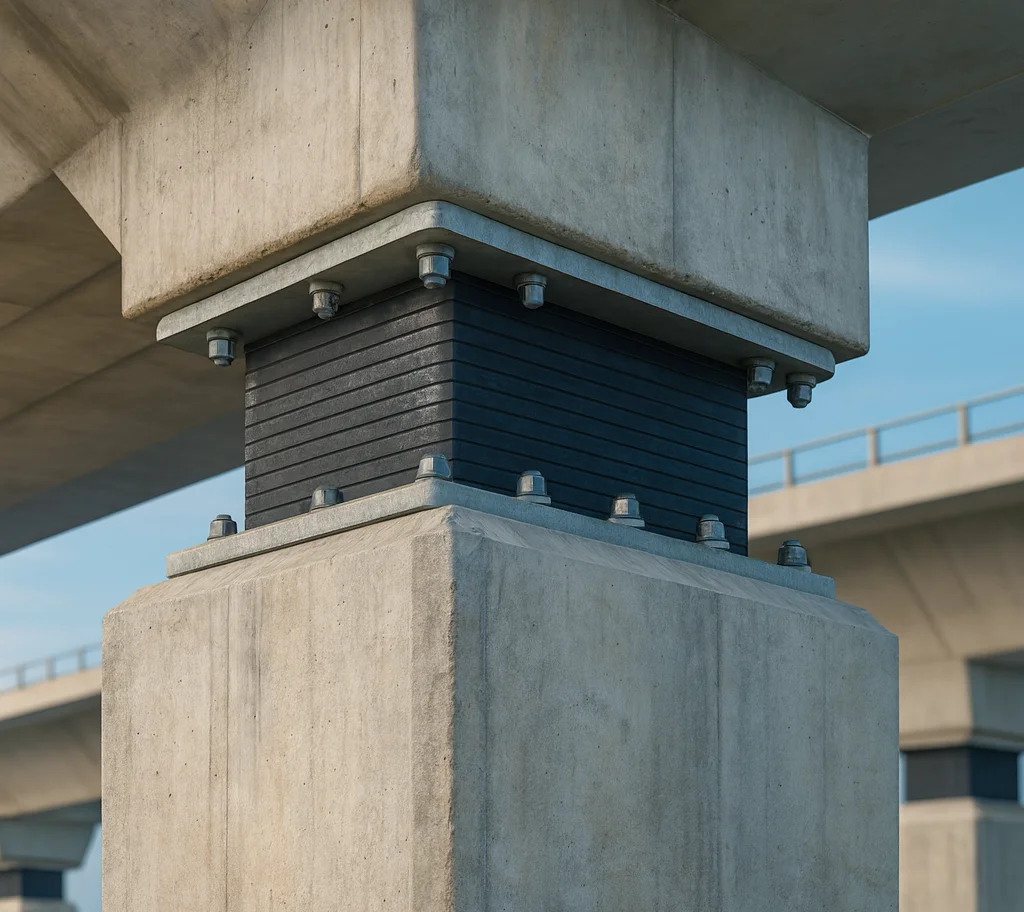
Types of neoprene bearing pads we supply:
| Type | Construction | Typical use |
|---|---|---|
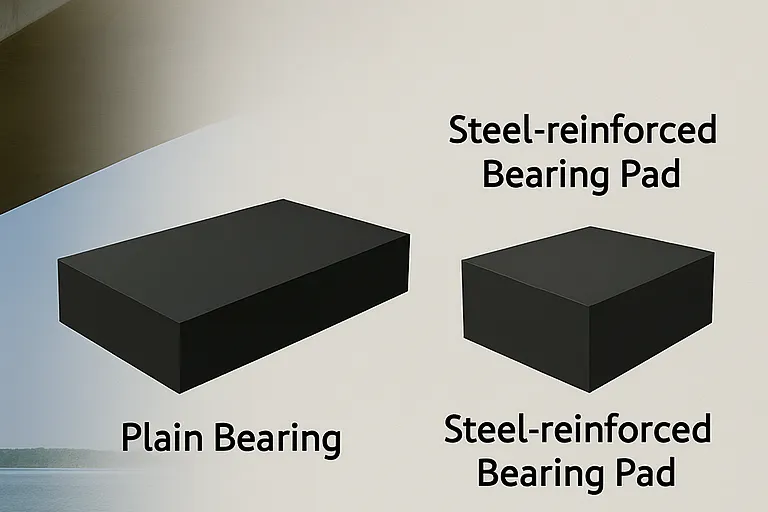
| Plain neoprene pads | Solid neoprene, no reinforcement | Precast panels, beams on light supports, equipment and pipe supports, low-load applications |
| Fabric-reinforced neoprene pads | Neoprene with embedded fabric layers | Moderate loads where extra stiffness and reduced bulging are needed |
| Steel-laminated neoprene pads | Neoprene bonded to internal steel plates | Highway and metro bridges, flyovers, heavy girders and high-load structural bearings |
| Strips and custom-cut pads | Cut or moulded to drawing | Expansion joints, panel seating, custom bearing schedules |
Not sure which one your project needs? Send the bearing schedule or load data and we will recommend the right type. See steel-laminated vs plain neoprene bearing pads.

Why Neoprene for Bearing Pads?
Bearing pads sit between a structure and its support. They carry the vertical load while letting the structure move: thermal expansion and contraction, rotation, and small horizontal shifts. Neoprene is the standard material for this job because it combines:
- High load capacity with controlled flexibility: compresses under load without losing its shape
- Weather and ozone resistance: stays stable under intense sun and UV, which matters in Saudi conditions
- Oil and chemical resistance: better than natural rubber around fuels, lubricants and industrial atmospheres
- Long service life with no maintenance: installed once, no lubrication or adjustment
- Quiet, vibration-damping behaviour: reduces transmitted vibration and noise
Where Neoprene Bearing Pads Are Used
- Highway bridges, flyovers and overpasses
- Metro and rail infrastructure
- Precast concrete beams, slabs and wall panels
- Industrial and oil and gas structures, pipe racks and equipment supports
- Commercial, leisure and entertainment developments
Why Buy from Diode Trading EST
- Stock in Dammam, delivery across KSA: short lead times for the Eastern Province and fast dispatch to Riyadh and Jeddah
- Submittal-ready documentation: datasheets, Material Test Certificate and compliance matrix support for consultant approval
- Custom sizes: cut to your bearing schedule, no forcing standard sizes onto your design
- Trusted by major Saudi clients: Saudi Aramco, SABIC, NEOM, Red Sea Global, Zahid Group and Qiddiya
- Local support: a Saudi-based team you can call, not a distant trading desk
How to Order
- Send your bearing schedule, drawing or load data to sales@diode.sa (or use the quote form)
- Tell us the pad type, size, thickness, hardness and quantity (if unsure, we will advise)
- Receive a quotation and technical submittal
- Approval, production or cutting, Material Test Certificate and delivery
Related Pages and Guides
Neoprene Bearing Pads FAQs
Q1. What are neoprene bearing pads used for?
A. They transfer load from a bridge girder, precast element or structure to its support while allowing small movements from temperature change, rotation and vibration.
Q2. What is the difference between plain and steel-laminated neoprene bearing pads?
A. Plain pads are solid neoprene and suit lighter loads. Steel-laminated pads have internal steel plates that limit bulging, so they carry much higher loads and are the standard choice for bridges and heavy girders.
Q3. What hardness should I choose?
A. Shore A 60 is the most commonly specified for bridge and precast work. Your design engineer sets the final hardness based on load, movement and shape factor, and we supply to that specification.
Q4. Do you supply AASHTO M251 neoprene bearing pads?
A. Yes. We supply pads to AASHTO M251 / ASTM D2000 requirements, and every order comes with a Material Test Certificate. Tell us the project specification and we will match it.
Q5. Can neoprene bearing pads handle Saudi Arabian heat?
A. Yes. Neoprene is resistant to ozone, UV and weathering and performs across a wide temperature range, which suits Saudi Arabia’s climate when specified and sized correctly.
Q6. Can you cut pads to custom sizes?
A. Yes. We supply to your drawing or bearing schedule, in the size and thickness your design requires.
Q7. Do you provide documentation for consultant approval?
A. Yes. We provide datasheets, the Material Test Certificate and compliance support for submittals.
Q8. Which cities do you deliver to?
A. All of Saudi Arabia from our Dammam warehouse, including Dammam, Al Khobar, Jubail, Riyadh, Jeddah, NEOM and the Red Sea region.
Neoprene Bearing Pads PRODUCT GALLERY







BRANDS WE TRUST


