


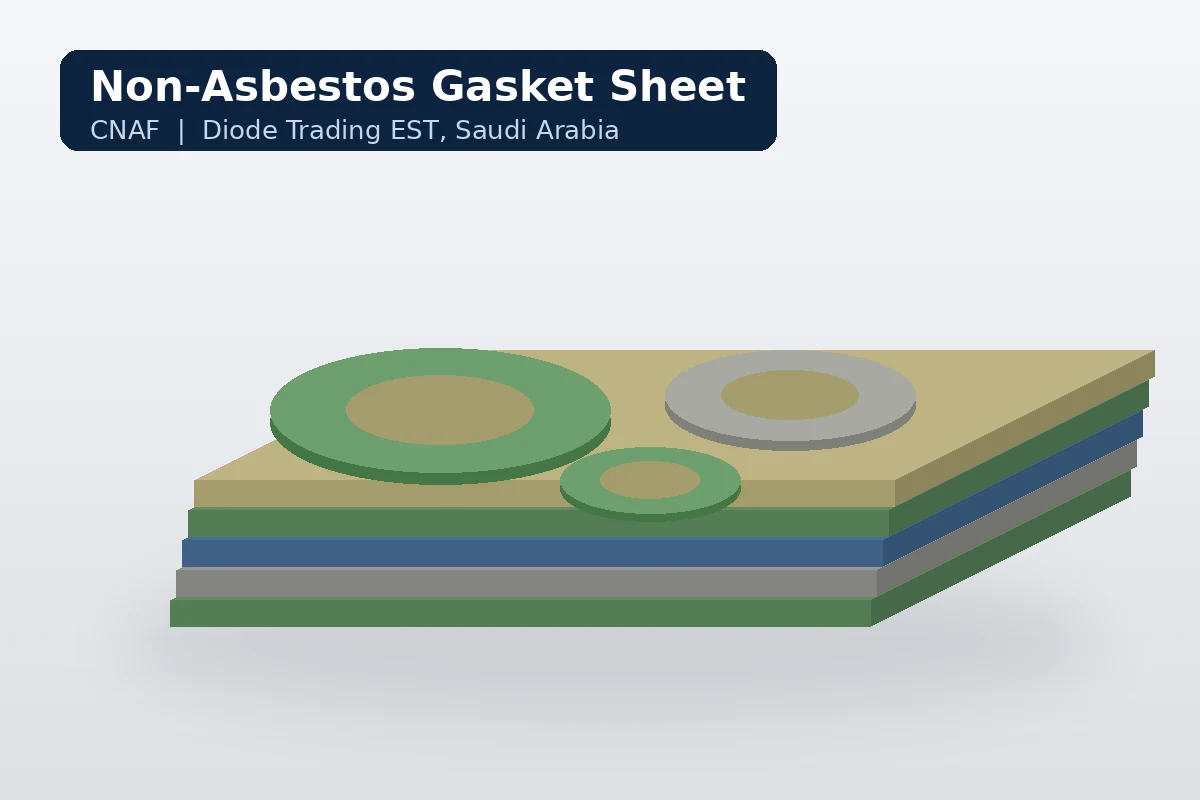
Non-Asbestos Gasket Sheet (CNAF) — Asbestos-Free Jointing Sheet
Technical Specification
| Material: | Compressed non-asbestos fibre (CNAF): aramid, glass or carbon fibres with mineral fillers and a rubber binder (typically NBR) |
|---|---|
| Grades: | General-purpose aramid/NBR, glass fibre, carbon fibre, graphite-faced and wire-reinforced |
| Typical Thickness: | Approx. 0.5 mm to 6 mm (1.5 mm and 3 mm most common for flanges) |
| Typical Sheet Sizes: | Approx. 1500 x 1500 mm and larger formats, depending on grade |
| Temperature and Pressure: | Grade dependent; confirm against the datasheet and P x T chart for your service |
| Supply: | Full sheets, cut-to-size pieces, ring (IBC) and full-face gaskets |
| Flange Standards: | ASME B16.21 / B16.5, EN 1514-1 / EN 1092-1, or to drawing |
| Note: | Figures are typical; confirm exact grade, size and rating with our team |
What Is Non-Asbestos Gasket Sheet?
Non-asbestos gasket sheet, also called CNAF (compressed non-asbestos fibre) or non-asbestos jointing sheet, is a flat sealing material made from synthetic or mineral fibres bonded with rubber. It is cut into flange gaskets for water, steam, oils, fuels, gases and many chemicals. It replaced compressed asbestos fibre (CAF) sheet, which was once standard but is now banned in Saudi Arabia and many other countries because of the health risk from asbestos fibres.
Key Benefits
- Asbestos-free: safe to cut, handle and dispose of
- Versatile: one sheet can be cut into many gasket sizes and shapes
- Good sealing: compresses into flange surface irregularities under bolt load
- Grade options: aramid, glass and carbon fibre grades for different temperatures and media
Grades We Supply
- Aramid fibre / NBR: general-purpose sheet for water, air, oils, fuels and low-pressure steam
- Glass fibre: good for many acids and alkalis
- Carbon fibre: higher temperature and steam service
- Graphite-faced or wire-reinforced: for more demanding temperature and pressure
- Cut gaskets: ring and full-face gaskets cut from any grade to ASME, EN or customer drawings
Asbestos Sheet Replacement
If a drawing, old purchase order or maintenance record still calls for “asbestos sheet” or CAF gaskets, specify non-asbestos gasket sheet (CNAF) instead. Match the CNAF grade to the fluid, temperature and pressure of the original service, and check that the flange bolting can seat the new gasket. When removing old gaskets that may contain asbestos, follow your site’s asbestos handling procedure.
How to Choose a Non-Asbestos Sheet
- Fluid: water, steam, oil, fuel, gas or chemical. Check chemical compatibility for the binder and fibre.
- Temperature and pressure: use the grade’s P x T chart, not just the maximum temperature.
- Thickness: use the thinnest gasket that suits the flange condition; thinner gaskets generally seal better at higher pressure.
- Flange: standard, size and pressure class, or a drawing for non-standard joints.
When to Choose Another Material
For strong acids, solvents or high-purity service, PTFE (Teflon) gaskets are usually better. For low-pressure water and air, rubber sheets may be more economical. For high-temperature steam and hydrocarbons, consider graphite or spiral wound gaskets. See also: Gaskets & Seal Materials, Ready-Cut Gaskets and PTFE (Teflon) Sheet.
Send us the flange standard, size and pressure class (or a drawing), the process fluid, temperature and pressure, and the quantity. Our Al Khobar team will recommend a grade and quote sheets or cut gaskets for delivery anywhere in Saudi Arabia and the GCC. Every order is supplied with a Material Test Certificate.
Frequently Asked Questions
Q1. What is CNAF gasket sheet?
A. CNAF stands for compressed non-asbestos fibre. It is a gasket sheet made from aramid, glass or carbon fibres bonded with rubber, used to cut flange gaskets.
Q2. Can I still buy asbestos gasket sheet in Saudi Arabia?
A. No. Asbestos is banned in Saudi Arabia. Non-asbestos gasket sheet (CNAF) is the standard replacement.
Q3. What thickness of non-asbestos sheet do I need?
A. 1.5 mm and 3 mm are the most common for pipe flanges. Thinner gaskets generally seal better at higher pressure if the flange faces are in good condition.
Q4. Can you cut gaskets from non-asbestos sheet?
A. Yes. We supply full sheets or ring and full-face gaskets cut to ASME, EN or your drawing.
Q5. What temperature can non-asbestos sheet handle?
A. It depends on the grade. Carbon fibre and graphite-faced grades handle higher temperatures than general-purpose aramid grades. Check the P x T chart for your service.
BRANDS WE TRUST


