


 05 October, 2026 |
  Admin
Admin
PTFE Components for Food &
Food and beverage processing equipment needs
Read more
Enquire Now
 26 September, 2026 | Admin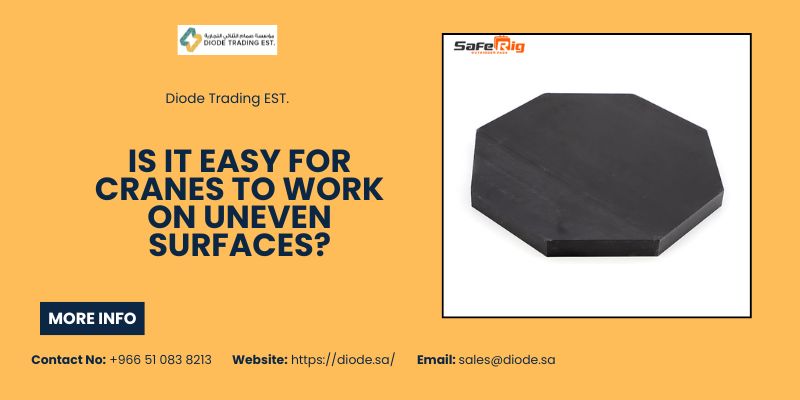
Ask most people what stops a mobile crane from tipping over mid-lift and they’ll point to the outrigger pad under each corner. That’s only half the system. The pad sits under a much bigger mechanical assembly – the outrigger itself – and understanding how that assembly works is what actually helps you set a lift up correctly, catch a bad configuration before it becomes an incident, and know what your crane can and can’t do on a given site. Here’s how the system is built, the four main outrigger designs you’ll run into on Saudi sites, and how the whole thing comes together at setup.
An outrigger is a retractable steel beam that extends horizontally from a mobile crane’s chassis, then lowers a hydraulic leg to the ground to lift the crane’s wheels clear of the surface. Instead of balancing on a narrow wheelbase, the crane now stands on a much wider, fixed footprint formed by four (sometimes more) outrigger legs. That wider footprint is what makes controlled lifting possible – without it, a mobile crane could only handle a fraction of its rated capacity before the load’s leverage tipped it over.
The moment a crane picks up a load, its centre of gravity shifts away from the chassis and out toward the boom tip. That creates a tipping moment – the load, in effect, is trying to pull the crane over sideways or forward. A crane’s tyres and axles give it a support base of roughly 3 to 4 metres wide, which is nowhere near enough to resist that moment once any real load comes on the hook. Extending the outriggers pushes the effective support base out to 8 metres or more on a mid-size all-terrain crane, and considerably further on larger units. That wider base is what the load chart is actually built around – every rated capacity figure in the manufacturer’s chart assumes the outriggers are extended to a specific, documented position.
Not every crane extends its outriggers the same way. The four configurations below cover most of the mobile and crawler cranes working on Saudi sites today.
| Configuration | How It Extends | Where You’ll See It |
| H-Style (independent, box-type) | Four beams extend independently, straight out from each corner | Most all-terrain and truck-mounted cranes; the most common layout on Saudi sites |
| A-Frame | Beams pivot outward and down from a fixed pivot point near the chassis centreline | Smaller carry-deck and pick-and-carry cranes |
| X-Style (crisscross) | Beams extend at an angle, crossing under the chassis for a wider spread in a shorter footprint | Cranes working in confined yards or congested plant areas where a full H-style spread won’t fit |
| Fixed (non-telescoping) | Beams are a set length and simply pivot down – no telescoping extension | Smaller mobile cranes and some articulated loader cranes with a fixed capacity range |
H-style outriggers are the ones you’ll size outrigger pads for most often on Saudi Aramco, SABIC, and general construction sites, since they’re the default on the all-terrain and truck cranes used across the Eastern Province, Riyadh, and the giga-project sites.
Five parts work together every time an outrigger is deployed:
The sequence matters, and skipping a step is one of the more common ways a lift goes wrong before the load even comes off the ground:
On Saudi Aramco sites, this sequence is formalised under the critical lift documentation in GI 7.028, and SABIC applies its own site-specific requirements at facilities like Jubail and Yanbu – see our SABIC site standards guide for the specifics.
The outrigger is the crane’s own beam-and-jack mechanism that extends out and lowers to the ground. The outrigger pad is a separate item placed under the outrigger’s foot to spread that point load across a wider area of ground. The crane comes with the outrigger built in; the pad is selected separately for the site and load.
No. Larger all-terrain cranes typically use independent H-style outriggers, while smaller carry-deck units may use A-frame or fixed designs. The type affects how much clearance you need on site and how the reaction force is distributed at each corner.
Only if the load chart for that specific partial extension allows it – and the rated capacity at partial extension is always lower than at full extension. The operator has to work from the load chart for the actual outrigger position, not assume full-extension figures apply.
Yes. Even reinforced concrete has a bearing capacity limit, and an outrigger float without a pad concentrates the full reaction force onto a very small contact area. Pads are required on essentially all surface types on Saudi Aramco and SABIC sites, regardless of how solid the ground appears.
Diode Trading EST supplies Saferig UHMWPE outrigger pads across the standard size range used on Saudi sites, along with custom fabrication for non-standard footprints. Use our sizing calculator to get a starting size for your equipment.
See our range of high-visibility safety mats and markers designed to reduce trip hazards across your site.
 05 October, 2026 | Admin
Food and beverage processing equipment needs
Read more 05 October, 2026 | Admin
Pharmaceutical manufacturing environments dem
Read more 04 October, 2026 | Admin
Semiconductor and electronics manufacturing p
Read more