

 05 October, 2026 |
  Admin
Admin
PTFE Components for Food &
Food and beverage processing equipment needs
Read more
Enquire Now
 03 October, 2026 | Admin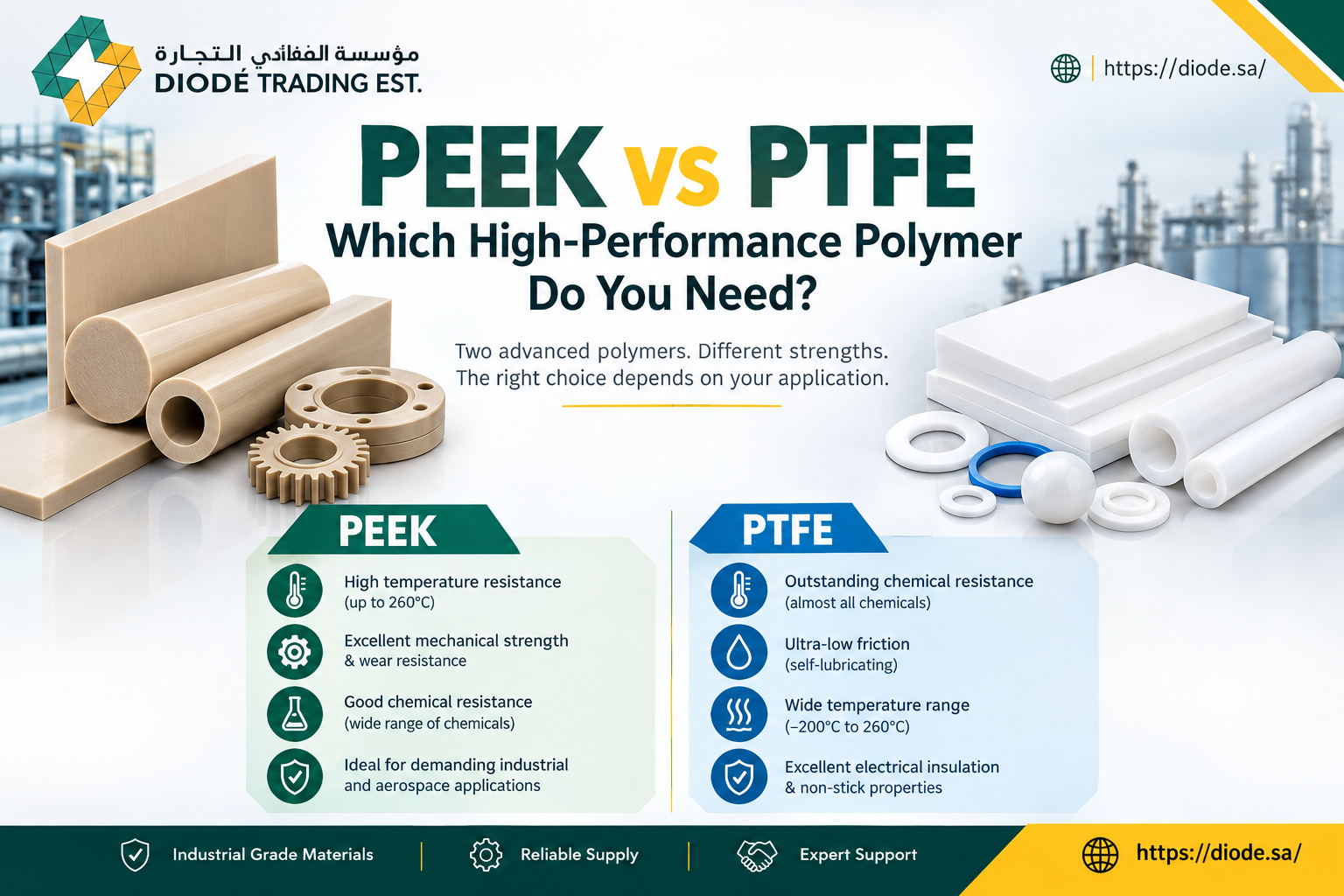
PEEK (Polyether Ether Ketone) and PTFE are both high-performance engineering polymers used where standard plastics fail, but they solve different problems. PTFE Engineering Plastics Riyadh The short version: PTFE wins on chemical resistance and friction; PEEK wins on mechanical strength and wear under load.
| Factor | PTFE | PEEK |
| Chemical resistance | Excellent — near-universal | Very good, but narrower than PTFE |
| Mechanical strength | Lower — relatively soft, prone to cold flow | Very high — one of the strongest engineering plastics |
| Expanded (ePTFE) | PTFE is mechanically expanded, creating a porous, highly compressible structure | Gasket sheet needing high conformability on imperfect flange surfaces |
| Wear resistance | Fair (better with fillers) | Excellent, even unfilled |
| Friction coefficient | Extremely low | Higher than PTFE |
| Max continuous temperature | ~260C | ~250C, but retains strength better at high temp |
| Cost | Moderate | High |
• Chemical exposure is the primary concern — PTFE’s chemical resistance is broader than PEEK’s
• Very low friction is required — seals, non-stick surfaces, low-friction bearings
• Cost is a significant factor — PTFE is generally less expensive than PEEK When PEEK Is the Better Choice
• The component carries structural or mechanical load — PEEK is dramatically stronger than PTFE
• High wear resistance is needed without relying on fillers
• The application needs a machined PTFE Engineering Plastics Dammam precision part that must hold its shape under load and heat
Yes, PEEK-filled or PEEK-blended PTFE grades exist, offering a middle ground between PTFE’s
chemical/friction properties and PEEK’s added mechanical strength for specific applications.

See our range of high-visibility safety mats and markers designed to reduce trip hazards across your site.
 05 October, 2026 | Admin
Food and beverage processing equipment needs
Read more 05 October, 2026 | Admin
Pharmaceutical manufacturing environments dem
Read more 04 October, 2026 | Admin
Semiconductor and electronics manufacturing p
Read more