
 28 August, 2026 |
  Admin
Admin
PTFE Sheets & Products Sa
PTFE — you might know it by the brand name
Read more
 27 August, 2026 | Admin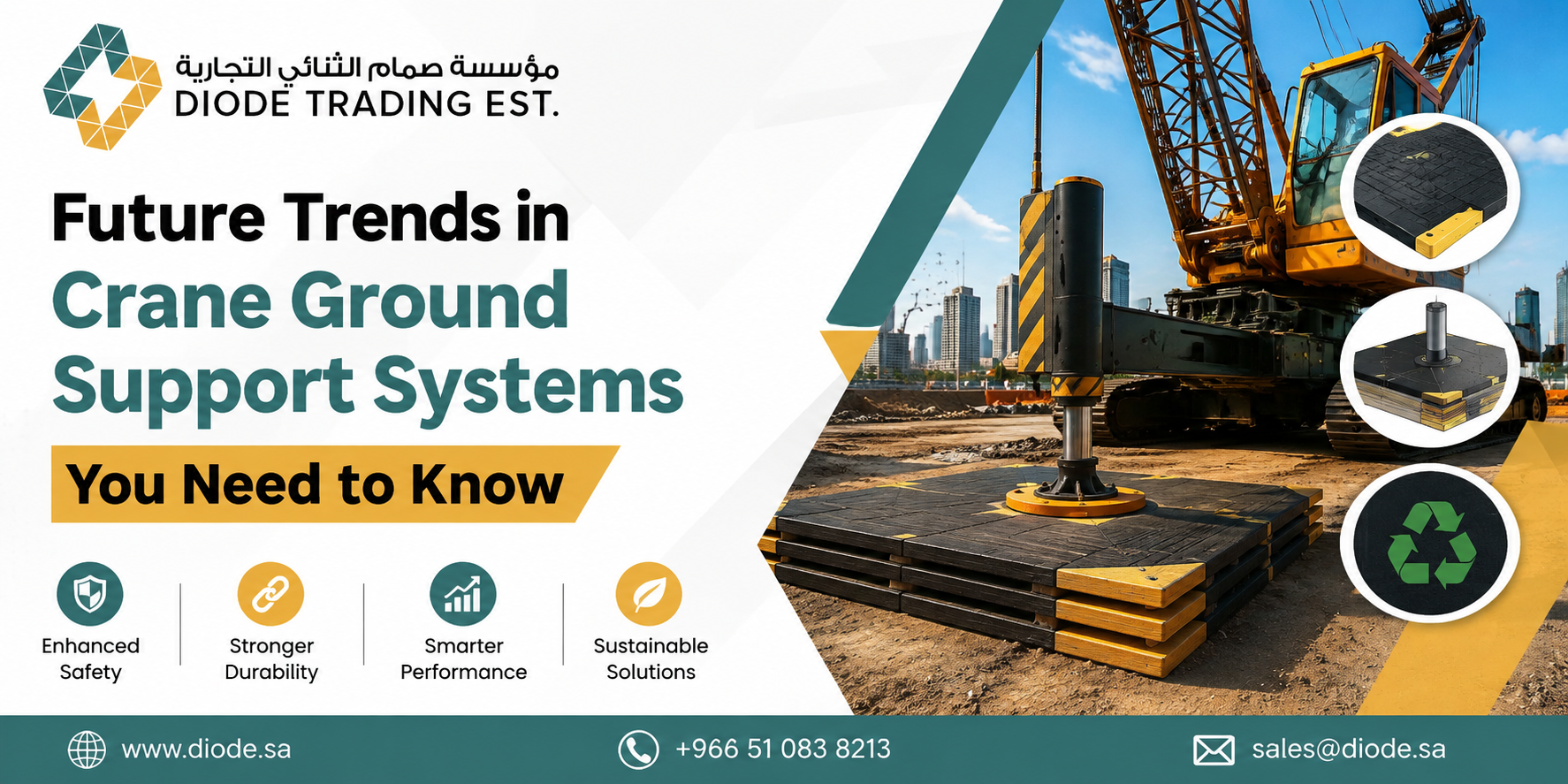
The evolution of crane ground support systems is rapid, since there have been more calls for efficiency, safety, and stability in both construction and heavy lifting. In current times, outrigger mats supplier in Saudi Arabia incorporates the use of materials that are durable in their designs.
There is the expectation that there will be more use of lighter but durable support systems, technology, and sustainable materials in the industry. These improvements will contribute to reducing the time taken for installation, enhancing crane stability, ensuring safety during lifting operations, and dealing with the challenges of modern construction projects.
The future of cranes in terms of ground support relies on technology and advanced materials that increase safety and efficiency in the field of construction and lifting operations.
One important advancement is the development of materials that can handle large amounts of weight without being excessively heavy themselves. Traditional steel structures have plenty of weight, making them hard to transport and requiring additional machinery to install them. New composite and engineered materials are much lighter in comparison, although equally strong. It’s as if we switched from a very heavy toolbox to a much lighter one, containing the same number of tools.
The use of composite materials as crane supports is increasingly being considered due to their robustness and durability as well as protection from weathering. Well-made composite materials are able to withstand heavy loads without problems such as moisture absorption, splitting, and non-uniform strength. As demand increases, an experienced outrigger pad supplier in Saudi Arabia can provide solutions that meet the tough local ground and weather conditions.
Sensors are likely to become a much bigger part of crane ground support. Imagine being able to see the pressure beneath each outrigger while the crane is working rather than relying only on calculations made before the lift. Real-time monitoring could give operators and site teams an early warning when ground conditions change or when a load is not being distributed as expected.
Ground conditions in a construction site are not always ideal. There could be compacted ground fill on one end, soft ground at another point, and recent excavation on the other end. All these factors will definitely be considered during the process of developing the structure. There are some solutions that would work in such cases.
The time required to set up support for cranes will influence cost. This is why manufacturers are trying to develop designs that are easy to position, connect, and dismantle in fewer moves. Some aspects like lifting points, interlocking edges, standardized sizes, and increased maneuverability will have their significance when the crane has to be relocated multiple times within the same project.
Most of these shifts will arrive gradually rather than all at once, so the practical takeaway for site teams today is to plan crane ground support systems around documented ground bearing capacity and a correctly rated pad, not just habit or whatever was used on the last job. As sensors, composite materials, and better modeling tools become standard, contractors who already treat ground support as an engineered decision will adopt them fastest.
Crane ground support is becoming more engineered, connected, and adaptable. Stronger materials, digital planning, real-time monitoring, and better load distribution will give lifting teams more information and greater control. It is surprising to see how the mat or pad placed below the outrigger of a crane may be considered a trivial part of the system, but the importance of this element keeps growing.
See our range of high-visibility safety mats and markers designed to reduce trip hazards across your site.
 28 August, 2026 | Admin
PTFE — you might know it by the brand name
Read more
27 August, 2026 | AdminThe evolution of crane ground support systems
Read more 27 August, 2026 | Admin
Neoprene bearing pads Saudi Arabia projects s
Read more